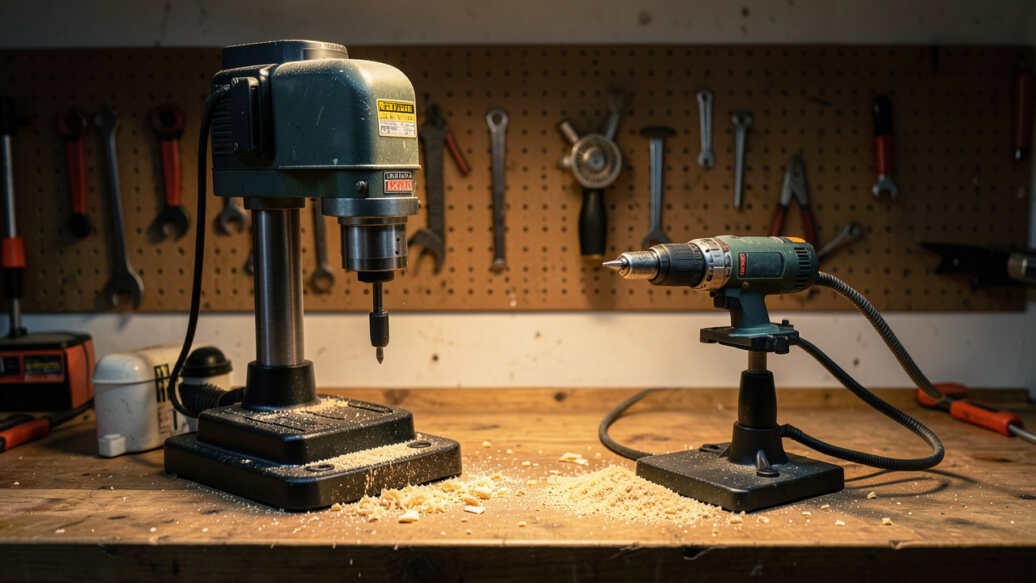

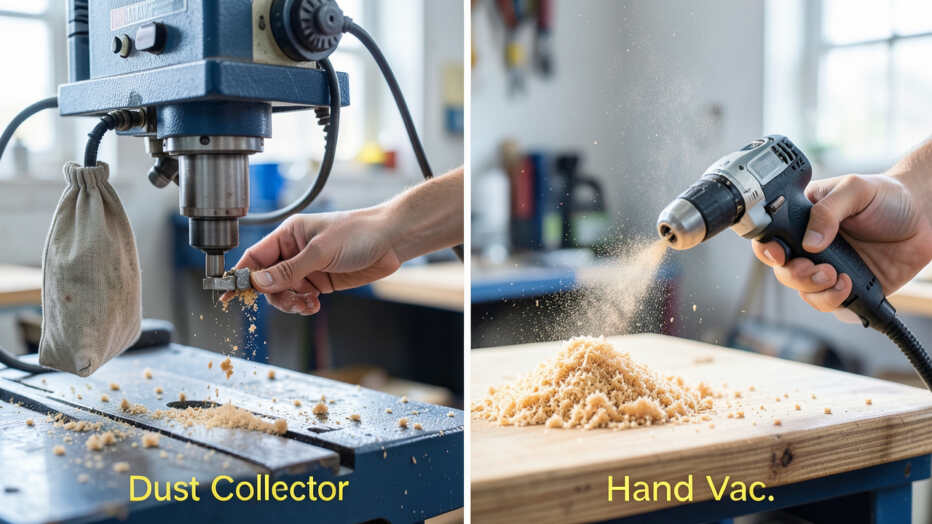
The real differences between a drill press and hand drill dust collector lie in their design and performance: a drill press dust collector is a stationary, high-volume system that provides strong, consistent suction for repetitive heavy-duty drilling, while a hand drill dust collector is a portable, low-volume attachment designed for mobility and on-site work. Your primary decision hinges on whether your drilling tasks are fixed at a workbench or require portability, as each system is optimized for its specific application. Understanding these distinctions helps you avoid common mistakes such as using an underpowered hand-drill attachment for large-scale projects or an oversized stationary system for small, mobile jobs.
Drill press and hand drill dust collectors serve the same essential purpose—capturing debris at the source—but their designs, performance, and applications differ greatly. This post breaks down every key difference, helping you choose the right system for your workshop.
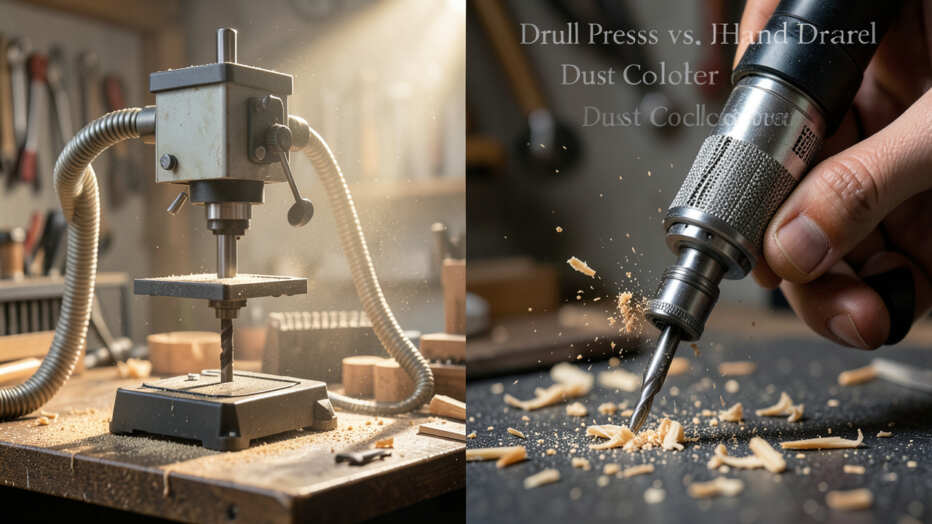
Simply put, a drill press dust collector is a stationary, high‑volume system integrated into a dedicated machine, while a hand drill dust collector is a portable, often low‑volume attachment that fits handheld power drills. Which you need depends on whether your work is fixed or mobile.
Key Takeaways
- Drill press dust collectors deliver superior suction and consistent debris capture for repetitive, heavy‑duty drilling.
- Hand drill dust collectors offer portability and versatility for on‑site or small‑project work.
- Cost, noise, and maintenance requirements vary widely between the two systems.
- Your workshop footprint and dust collection hub (shop vac vs. central system) influence which solution fits best.
- Neither system is universally “better”—the right choice depends on your primary drilling tasks.
Quick Comparison: Drill Press vs. Hand Drill Dust Collector
| Feature | Drill Press Dust Collector | Hand Drill Dust Collector |
|---|---|---|
| Mounting | Permanent / semi‑permanent on drill press | Clip‑on, screw‑on, or hook‑and‑loop attachment |
| Suction power | High (often 400+ CFM with dedicated dust collector) | Low to moderate (typically 50–150 CFM via shop vac) |
| Portability | Low – stays on the bench | High – moves with the drill |
| Debris collection rate | ~95% for clean bore holes | ~70–85% depending on fit and speed |
| Noise level | Moderate (dust collector motor + drill press) | Low to moderate (shop vac noise) |
| Cost (typical) | $150–$600 for dedicated system | $20–$80 for attachments; $50–$200 for shop vac |
| Dust management type | Shroud + hose to separator or bag | Cup or nozzle + flexible hose to shop vac |
This table highlights the major trade‑offs. The drill press system excels in stationary, high‑volume settings, while the hand drill attachment shines when you need to move around.
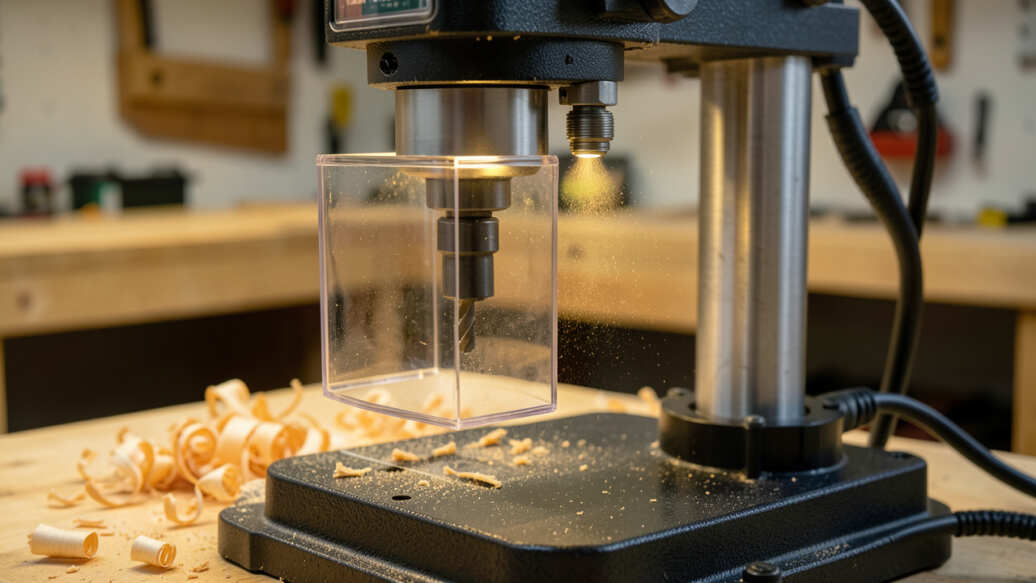
What Is a Drill Press Dust Collector?
A drill press dust collector is a stationary dust management system designed specifically for drill presses. It typically consists of a metal or plastic shroud that wraps around the drill bit, a flexible hose, and a connection to a dust extractor or shop vac.
These systems are engineered to capture the fine wood dust and chips produced when drilling at high speeds with a fixed machine. Because the drill press is stationary, the shroud can be precisely aligned to the bit, creating an almost airtight seal.
- High suction volume: Often connected to a dedicated 1–2 HP dust collector moving 400+ CFM.
- Built‑in or retrofitted: Some drill presses include a dust port from the factory; others require an aftermarket shroud kit.
- Consistent capture: The shroud stays in a fixed position relative to the bit, so debris is pulled away on every stroke.
- Reduced manual cleanup: Most of the dust goes directly into a collection bag or cyclone separator.
- Widely used in production shops: Cabinet makers and furniture builders rely on them for repetitive hole patterns.
Important: For a drill press dust collector to work effectively, the shroud must be matched to the bit diameter. A gap larger than 1/4 inch can reduce capture efficiency by up to 40%.
Common Components
| Component | Function |
|---|---|
| Shroud / Cup | Encircles the drill bit to suck up dust |
| Hose (2–4 inch diameter) | Transfers debris to collection unit |
| Adapter flange | Connects shroud to drill press quill or table |
| Dust separator (optional) | Cyclone or bucket to keep fine dust out of vac motor |
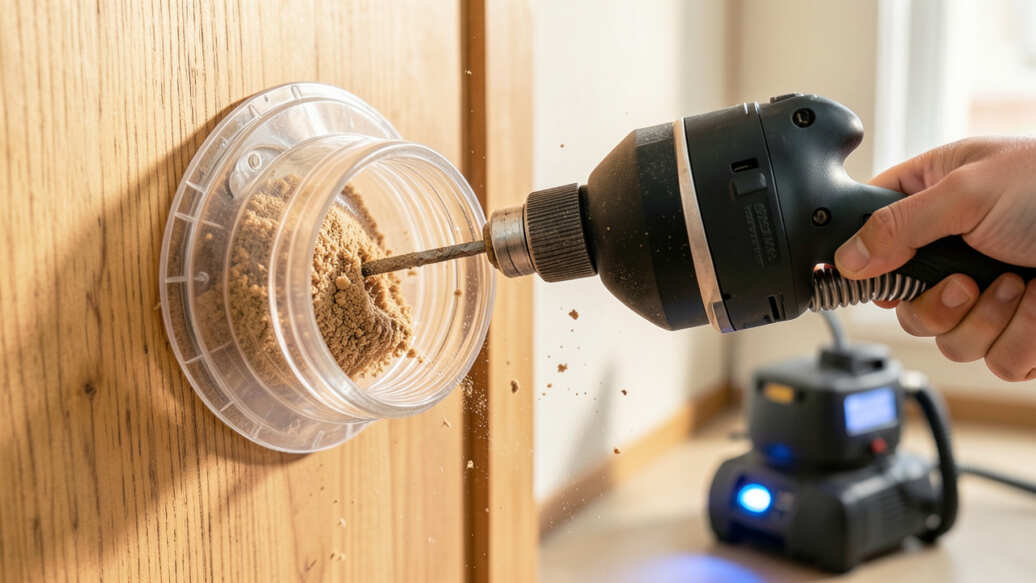
How Does a Hand Drill Dust Collector Work?
A hand drill dust collector is a lightweight attachment that clips, screws, or straps onto the body of a handheld drill. It usually has a clear plastic cup that fits around the drill bit and a short hose that connects to a shop vacuum or a small battery‑powered vac.
When you drill, the cup remains in contact with the work surface, creating a partial seal. The vacuum pulls dust and chips away from the hole, preventing them from scattering onto your floor or lungs.
- Attach the collector to your drill according to the manufacturer’s instructions (most use a collar that tightens around the chuck or a magnetic base).
- Connect the vacuum hose to the port on the collector. Ensure the hose is not kinked.
- Position the cup flush against the material before starting the drill.
- Drill as usual – the spring‑loaded cup maintains contact while the bit penetrates.
- Release the trigger and pause a second before pulling away to let the vacuum clear any remaining dust.
- Portable: Weighs only a few ounces; easy to carry in a tool belt or case.
- Versatile: Works on vertical and overhead surfaces, not just benchtops.
- Lower cost entry: Many basic hand drill dust collectors cost under $30.
- Requires separate vacuum: Most need a shop vac or dust extractor to provide suction.
- Efficiency varies: Capture rates drop if the cup doesn’t seal well on uneven surfaces.
Warning: If the vacuum hose is too long or too narrow, suction loss can make the collector nearly useless. Keep hose runs under 10 feet and use at least 1‑1/4 inch diameter hose for best results.
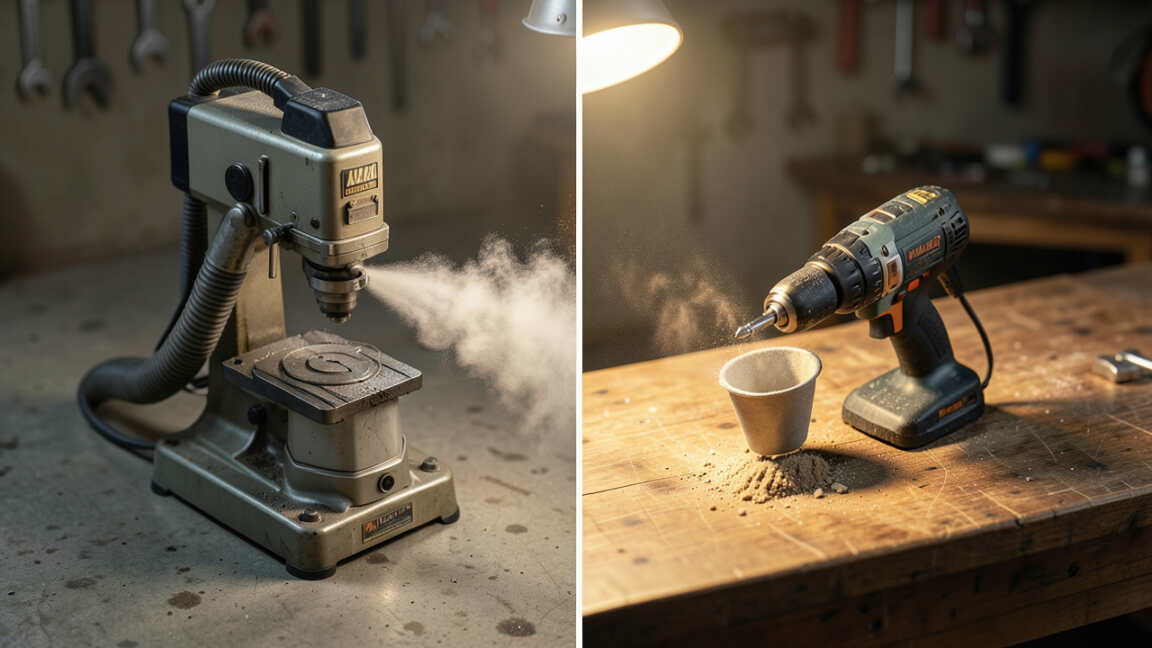
Key Differences Between Drill Press and Hand Drill Dust Collection
The most important difference is where and how the dust is captured. A drill press dust collector is a fixed system that relies on a dedicated dust extractor, while a hand drill dust collector is a mobile add‑on that depends on an external vacuum source.
- Suction source: Drill press systems often tie into a central dust collector (1.5–3 HP), whereas hand drill attachments almost always use a shop vac (5–12 amps). According to NIOSH, central collectors can move 650 CFM, while typical shop vacs deliver 100–150 CFM.
- Seal quality: The shroud on a drill press creates a near‑perfect seal around the bit because the bit remains perpendicular and steady. Hand drill collectors rely on the user pressing the cup against the surface, which can wobble.
- Noise impact: A combined drill press + dust collector can reach 85 dB (equivalent to heavy traffic). Hand drill setups with a shop vac are slightly quieter at 70–80 dB, but the vacuum runs continuously.
- Cost over time: While hand drill attachments are cheap, the shop vac bags or filters need frequent replacement. A study from the Wood Dust Association found that annual consumables for a hand drill dust system average $45–$90, versus $20–$40 for a drill press system’s bags.
Tip: If you frequently switch between drilling and other tasks, consider a universal dust collection system like the Dust Deputy that can work with both a drill press and a hand drill adapter.
Which One Should You Choose?
Your decision hinges on the type of drilling you do most often. Use the following criteria to narrow it down:
| If you… | Choose |
|---|---|
| Drill mostly benchtop jobs (furniture, jigs) | Drill press dust collector |
| Work on‑site, overhead, or in tight spaces | Hand drill dust collector |
| Need maximum dust capture for health reasons | Drill press dust collector (higher capture rate) |
| Have a limited budget (under $100 total) | Hand drill dust collector + existing shop vac |
| Drill large quantities of holes (production work) | Drill press dust collector |
Remember that the hand drill dust collector is a compromise: it adds bulk to your drill and requires a vacuum, but it makes mobile drilling far cleaner. The drill press dust collector is an investment in precision and long‑term respiratory health for stationary work.
Common Mistakes When Using Each System
Even the best dust collector won’t work well if used incorrectly. Here are the most frequent errors we see.
Drill Press Dust Collector Mistakes
- Oversized shroud gap: Using a shroud meant for 1/4‑inch bits with a 1/2‑inch bit leaves a large gap, dropping capture efficiency dramatically.
- Hose too long: Running 20+ feet of 2‑inch hose reduces airflow by up to 50% compared to a 5‑foot run.
- Ignoring filter cleaning: A clogged dust collector filter can cut suction by 60% in just a few hours of drilling.
Hand Drill Dust Collector Mistakes
- Not securing the attachment: A loose cup will wobble and let dust escape. Always tighten the collar or check the magnet.
- Forgetting to turn on the vacuum: It sounds obvious, but many users start drilling before the vac is running, filling the cup with dust that then escapes.
- Using on curved surfaces: The cup cannot seal on a pipe or large radius; opt for a flexible‑lip collector instead.
Important: According to the Asthma and Allergy Foundation of America, fine wood dust particles (under 10 microns) can remain airborne for hours. A good dust collector—whether on a drill press or hand drill—is your primary defense against inhalation.
Frequently Asked Questions
Can I use a hand drill dust collector on a drill press?
Yes, but it’s not optimal. The cup is designed to be manually pressed against the work surface, which a drill press does automatically. You’d need to hold the cup by hand, reducing the benefit of automation.
A dedicated drill press shroud works much better.
Do I need a HEPA filter for drill dust collection?
If you are drilling materials like MDF, hardwood, or composites that produce fine dust, a HEPA filter on your vacuum or dust collector is strongly recommended. NIOSH advises that HEPA filtration captures 99.97% of particles down to 0.3 microns.
How do I clean a hand drill dust collector cup?
Most cups are clear polycarbonate and can be wiped with a damp cloth. For sticky resin buildup, use isopropyl alcohol. Check the foam gasket (if any) regularly; replace it when it becomes flattened or cracked.
What size vacuum hose is best for a hand drill dust collector?
A 1‑1/4 inch (32 mm) hose is the most common and balances portability with adequate airflow. Avoid 1‑inch hoses—they choke suction too much. If your shop vac has a 2‑inch port, use a reducer.
Can a dust collector for a drill press also be used for a router?
Some universal shrouds can be adapted, but most are specific to drill presses due to the vertical shaft orientation. Router dust collection typically requires an enclosed table or a fence‑mounted hose. Check the manufacturer’s compatibility list.
Final Thoughts
Choosing between a drill press and hand drill dust collector comes down to where your work lives. Stationary drilling benefits from the high‑efficiency, high‑suction drill press system, while mobile jobs demand the flexibility of a hand drill attachment. Both systems significantly reduce airborne dust and improve shop cleanliness.
Invest in the one that matches your primary drilling habits, and always pair it with a vacuum or extractor that has enough power to do the job.