
Pro contractors are rarely told that workshop compressor horsepower ratings are intentionally misleading and that actual CFM at the tool’s required pressure is the only spec that matters for real performance. Oil-free compressors fail two to three times faster than oil-lubricated units under continuous professional use, dramatically increasing long-term replacement costs. The true total cost of ownership, including electricity consumption and maintenance, far exceeds the purchase price and determines whether a compressor will last a decade or just past warranty.
Buying a workshop air compressor is often more complicated than it looks. Many pro contractors invest hundreds of dollars only to realize their unit can’t keep up with the tools they actually use on the job.
This guide reveals the five critical things manufacturers rarely mention – from deceptive horsepower ratings to the hidden costs of ownership. Read on before you make a purchase you’ll regret.
Simply put, most commercial compressors are overhyped on specs and undersized for real-world jobs. You need to ignore peak horsepower, focus on actual CFM at your tool’s PSI, and plan for a service life of 10+ years – not the first warranty period.
Key Takeaways
- Workshop air compressor ratings like HP and tank size rarely reflect real tool performance – CFM at your specific pressure is all that matters.
- Oil-free compressors fail 2–3 times faster than oil-lubricated units under continuous contractor use, increasing long-term costs.
- The total cost of ownership (electricity, maintenance, downtime) often exceeds the purchase price within two years if you choose the wrong model.
- Duty cycle is more critical than maximum pressure – a 100% duty cycle compressor costs more upfront but saves money over decades of daily use.
- Matching your compressor to your most air-hungry tool (not the average) prevents frustration and expensive upgrades later.
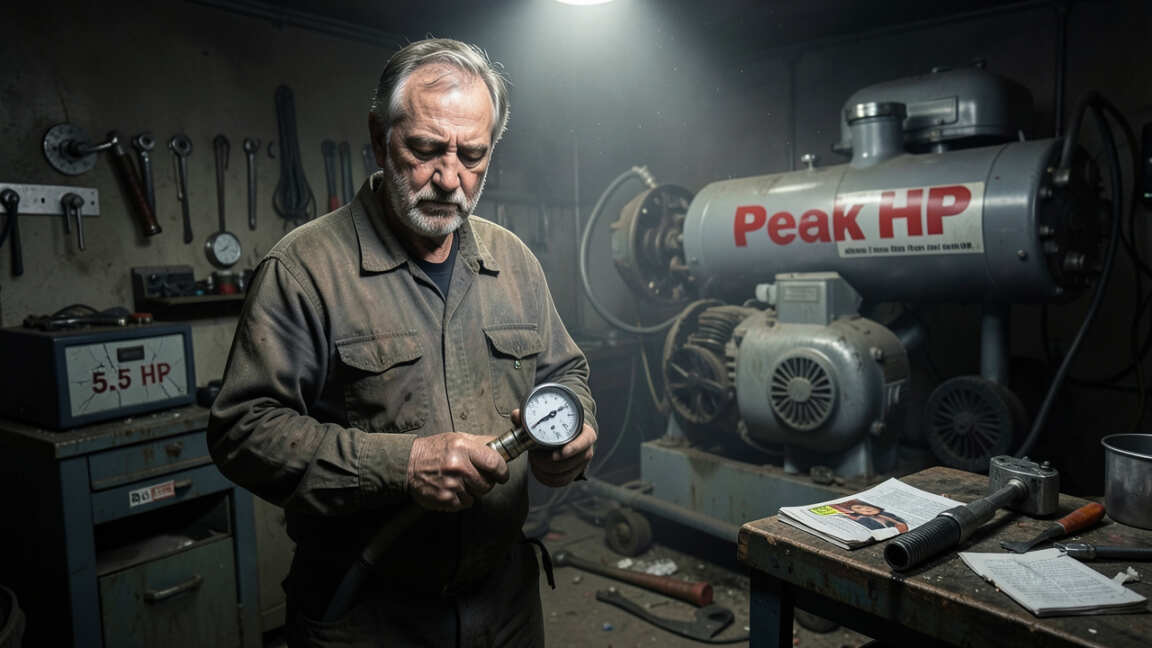
Peak Horsepower Ratings Are Designed to Mislead You
Walk into any equipment store and you’ll see compressors boasting “6.5 HP” or even “10 HP” from a standard 120-volt outlet. The math simply doesn’t add up. A typical 15-amp, 120-volt household circuit delivers about 1.8 peak horsepower at the motor shaft – anything higher is a marketing gimmick.
The FTC and several industry bodies have flagged this practice for years, yet it remains widespread. Contractors routinely buy “high-horsepower” units that actually produce less usable air than a properly rated 2 HP commercial model.
How to Spot Misleading Horsepower Claims
- Look for the motor’s “running amp draw” – true 5+ HP motors require 240V and pull 20+ amps.
- Ignore “peak horsepower” (often labelled as “max HP”) – it’s measured with no load for a split second.
- Demand the “actual CFM at 90 PSI” – this is the only number that tells you how much air the compressor delivers to your tools.
- Remember: a 1.5 HP motor with an efficient pump can outperform a 5 HP motor with a poorly designed pump.
- Check the pump’s displacement (CFD) – higher displacement at lower RPM means longer pump life.
- Compare units from different brands using CFM at 90 PSI, not horsepower.
- Ask the dealer for the manufacturer’s “performance test sheet” – reputable brands provide one.
Warning: Never rely on the “HP” number printed on the tank or motor – many manufacturers inflate it by using “developed horsepower” which has no industry standard.
According to the Compressed Air and Gas Institute (CAGI), a compressor’s actual output should be measured at a standard reference point (90 PSIG inlet condition). Only a handful of brands voluntarily submit to CAGI testing. Always ask for CAGI data sheets when evaluating a workshop air compressor for professional use.
The Real CFM You Need Depends on Your Most Greedy Tool
Most contractors add up the CFM of all their tools and buy a compressor that covers the total. That is a costly mistake. You rarely run every tool simultaneously – and your compressor’s recovery rate matters far more than the sum of tool CFM.
Instead, identify your single most air-hungry tool. For a framing crew, that might be a ¾-inch impact wrench requiring 8 CFM at 90 PSI. For a painting team, it could be a spray gun needing 12 CFM at 40 PSI.
Your compressor must deliver at least 1.5x that tool’s CFM requirement to avoid constant cycling.
Common Contractor Tools and Their Real CFM Demands
| Tool | Average CFM @ 90 PSI | Recommended Compressor CFM |
|---|---|---|
| Framing nailer | 2.5 – 3.5 | 5 – 6 |
| ½-inch impact wrench | 5 – 7 | 10 – 12 |
| HVLP spray gun | 8 – 13 | 12 – 18 |
| Air hammer / chisel | 4 – 6 | 8 – 10 |
| Orbital sander | 6 – 9 | 10 – 14 |
The numbers above assume continuous use. For intermittent use (e.g., driving nails every few seconds), a smaller tank with decent recovery can work. But for sanding, spraying, or grinding – buy big.
Important: Tools that run continuously (spray guns, sanders, grinders) require a compressor with at least a 60-gallon tank and a pump rated for 100% duty cycle. Anything less will overheat waiting for the tank to refill.
Older Compressor Types: Which Pump Design Lasts Decades?
Every pro contractor wants a workshop air compressor that runs daily without breakdowns. The pump design determines lifespan more than any other factor. There are three main types used in professional units, and each has a clear trade-off between cost, noise, and maintenance.
Pump Type Comparison for Contractor Use
| Pump Type | Typical Lifespan | Noise Level | Best For |
|---|---|---|---|
| Oil-lubricated reciprocating | 10,000+ hours | Medium (70–85 dB) | Daily professional use, heavy tools |
| Oil-free reciprocating | 500–1,500 hours | High (80–95 dB) | Light duty, hobbyists, intermittent use |
| Rotary screw | 20,000+ hours | Low (60–75 dB) | Workshops with multiple tools running all day |
Rotary screw compressors cost 3–5x more than reciprocating units but offer near-silent operation and virtually no vibration. For a crew working 8+ hours daily, the quieter environment improves communication and reduces hearing damage risk.
Duty Cycle: The Most Ignored Spec in Professional Shops
Most portable compressors list a “duty cycle” like 50% (e.g., run 5 minutes, rest 5 minutes). Pro contractors often ignore this because they plan to only use the tool intermittently. But the problem isn’t the tool – it’s the pump overheating when the tank empties and the motor immediately restarts.
A 50% duty cycle compressor running a spray gun for 10 minutes straight will overheat the pump after just 5 minutes of run time. The motor thermal cutoff shuts it down, halting your entire job. That’s why manufacturers like Quincy, Ingersoll Rand, and Sullair offer “100% duty cycle” models designed for continuous operation.
Why Duty Cycle Matters More Than Tank Size
- A 60-gallon tank with a 50% duty cycle pump still has a 50% duty cycle – the tank just delays the overheating.
- Continuous-use tools (sanders, grinders, blasting cabinets) require a 100% duty cycle compressor.
- Even intermittent users like framers benefit from a 75%+ duty cycle: it reduces pump wear and allows faster recovery.
- Many “professional” compressors from big-box stores actually have a 25% duty cycle – fine for homeowner use but not for contractors.
- To calculate run time: divide the pump’s “run time” rating by the duty cycle percentage. A 5-minute run with 50% duty = pump must rest 5 minutes before next run.
Tip: Look for the words “continuous duty” or “100% duty cycle” on the spec sheet. If it’s not listed, assume 25% to be safe. Brands like Eaton Compressor and BelAire proudly advertise 100% duty on their commercial models.
Total Cost of Ownership: Electricity and Maintenance Eat Your Profit
Pro contractors often compare only the purchase price of a workshop air compressor. Yet the electric bill for running that compressor over five years often exceeds the machine’s cost. A 5 HP single-stage unit running 40 hours per week at $0.12/kWh costs about $1,400 per year in electricity alone.
Add in oil changes, air filter replacements, belt adjustments, and possible valve rebuilds, and the five-year TCO can be 2–3 times the purchase price. A more efficient two-stage or rotary screw compressor can cut electricity costs by 20–30% while lasting 3x longer than an oil-free unit.
15-Year Cost Comparison: Two-Stage vs. Oil-Free Reciprocating
| Cost Category | Two-Stage Oil-Lubricated (5 HP) | Oil-Free Single-Stage (5 HP) |
|---|---|---|
| Purchase price | $2,800 | $1,200 |
| Electricity (5 years, 40 hrs/wk) | $5,100 | $6,800 |
| Maintenance (5 years) | $600 | $1,200 (frequent rebuilds) |
| Expected lifespan | 12–15 years | 2–4 years |
| Total 5-year cost | $8,500 | $9,200 |
The oil-free compressor appears cheaper up front but costs more over five years because of higher electricity consumption and shorter lifespan. The two-stage unit also retains resale value – used commercial compressors often sell for 40–50% of original cost after a decade of service.
Why You Need a Compressor That Outgrows Your Current Shop
Many contractors buy based on their immediate needs – a few nailers and a blow gun. Within a year, they add a spray booth, a sandblaster, or an air-fed respirator system. Suddenly the compressor that seemed adequate is running nonstop, and upgrading costs double what a bigger unit would have cost initially.
Industry data from CAGI shows that 70% of professional users upgrade to a larger compressor within three years of their first purchase. The reason: job sites change, tool inventories expand, and efficiency demands increase. A workshop air compressor should be purchased with a five-year growth plan in mind.
Questions to Ask Yourself Before Sizing Up
- Am I planning to add any continuous-use tools (spray guns, sanders, media blasters) in the next 3 years?
- Will I be running multiple tools at once (e.g., two sprayers simultaneously)?
- Do I anticipate needing higher PSI for any specific application (e.g., certain demolition tools need 150+ PSI)?
- Will I add a second worker who needs a separate tool connected at the same time?
- Is there space in my workshop for a 80-gallon or 120-gallon tank?
Tip: A good rule of thumb: buy a compressor that delivers 1.5x the CFM you think you need today. That buffer covers future tools and reduces run time, extending pump life.
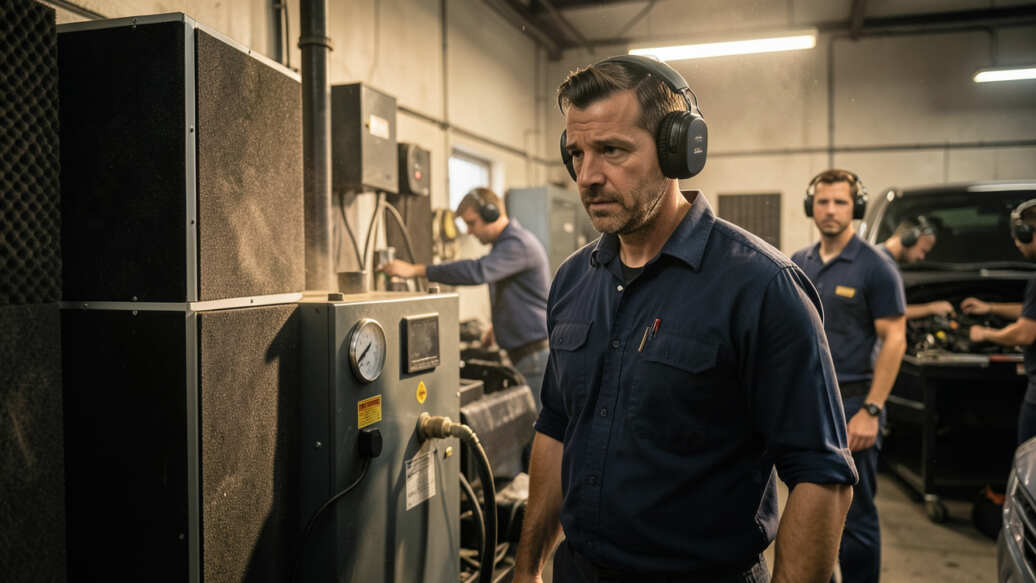
Noise Levels Quietly Impact Your Health and Crew Morale
Noise is often an afterthought when choosing a workshop air compressor. But prolonged exposure to 85 dB or above causes permanent hearing loss. Many portable compressors hit 90–100 dB at close range – louder than a chainsaw.
Pro contractors working 8-hour days next to these units without hearing protection face serious long-term health risks.
OSHA mandates hearing protection above 85 dB over an 8-hour TWA. But even with earplugs, the constant drone increases fatigue and reduces concentration. Rotary screw compressors run at 60–75 dB – about as loud as a normal conversation.
The price premium (often $1,000–$2,000 more) pays for itself in worker comfort and safety.
Noise Reduction Strategies for Contractor Shops
- Place the compressor in a separate room or outside shed with sound-damping walls.
- Use a longer air hose (50–100 feet) to move the compressor away from the work area.
- Install a muffler kit on the intake – many aftermarket models reduce intake noise by 5–10 dB.
- Choose a belt-driven pump over direct-drive: belts naturally reduce high-frequency noise.
- Consider a sound-dampening enclosure (commercial models like the California Air Tools 10020C are built for quiet operation).
- Measure noise with a smartphone app – anything above 85 dB at the operator’s position requires hearing protection.
Important: A quiet compressor isn’t just about comfort – it reduces the risk of OSHA violations on commercial job sites. Many general contractors now require on-site compressors to stay below 80 dB.
What Nobody Tells You About Tank Size and Pressure Drop
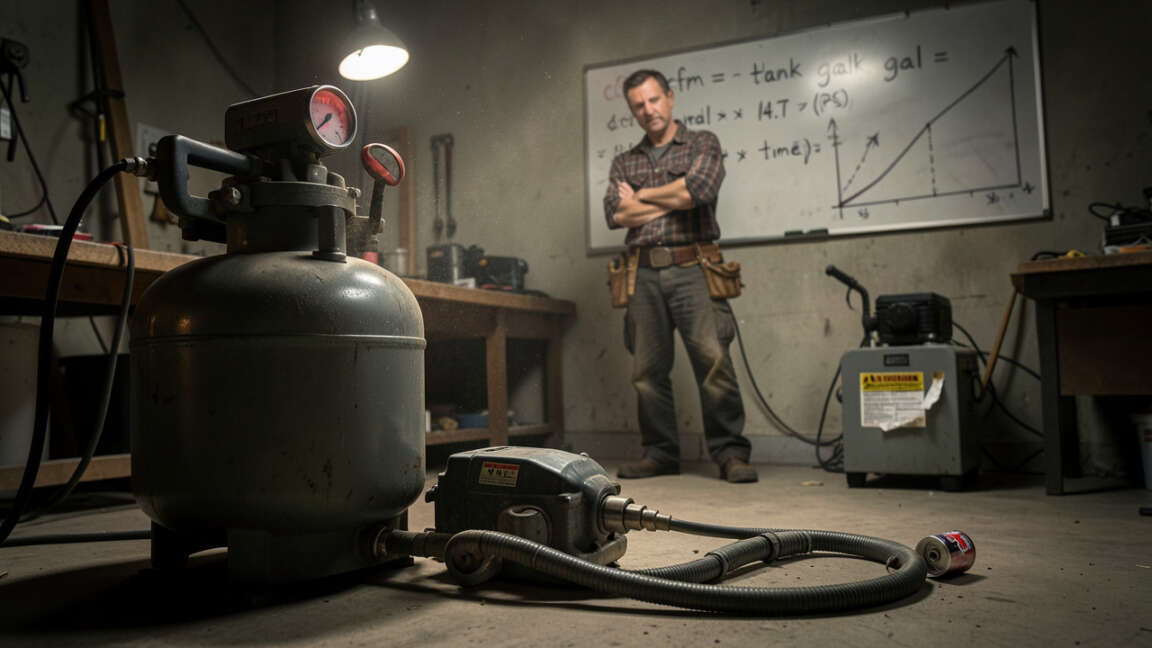
Bigger isn’t always better when it comes to tank size, but there is one rule: tank size should match your largest tool’s air consumption. A 60-gallon tank is standard for most contractor shops, but a 120-gallon tank can keep a spray gun running for 2–3 minutes without the pump kicking in – critical for finish work where pressure fluctuation shows in the paint pattern.
Pressure drop across the tank, regulator, and hoses is another hidden issue. A regulator set to 90 PSI might actually deliver only 75 PSI at the tool because of friction losses in long hoses and restrictive fittings. This forces the compressor to run longer and work harder.
How to Minimize Pressure Drop in Your System
| Component | Recommended Upgrade | Effect on Pressure Drop |
|---|---|---|
| Hose diameter | 3/8″ instead of 1/4″ | Reduces drop by 30-50% over 50 ft |
| Couplers | High-flow (3/8″ NPT) couplers | Eliminates 5-10 PSI restriction |
| Filter/regulator | In-line filter with 1/2″ ports | Improves flow at regulator by 20% |
Pro contractors often replace the factory-installed regulator with a high-flow model immediately after purchase. It’s a $30 upgrade that can make a 60-gallon compressor perform like an 80-gallon unit by reducing pressure drop and allowing the pump to cycle less often.
Frequently Asked Questions
What CFM does a framing crew actually need from a workshop air compressor?
A framing crew typically runs one nailer at a time, requiring 2–4 CFM at 90 PSI. However, the compressor must also have a high recovery rate to keep up during rapid nailing. A 5–6 CFM compressor with a 60-gallon tank is the minimum for a two-person crew.
Is oil-free or oil-lubricated better for a professional workshop?
Oil-lubricated compressors are vastly superior for professional use. They last 5–10 times longer than oil-free units, run cooler, and are quieter. Oil-free compressors are designed for light, intermittent use – not for contractors running tools daily.
Always choose oil-lubricated for a commercial shop.
Can a 120-volt compressor power an HVLP spray gun?
Most 120-volt compressors cannot sustain an HVLP spray gun for more than 1–2 minutes because they lack the CFM needed for continuous spraying. A 240-volt, 5 HP compressor with a 60-gallon tank and 100% duty cycle is the minimum for production spray work. Anything less will overheat and shut down.
How often should I change the oil in my workshop air compressor?
For piston-type oil-lubricated compressors, change the oil every 500–1,000 hours of run time or every 6–12 months, whichever comes first. Use a non-detergent 30-weight compressor oil. Rotary screw compressors require synthetic oil changes every 2,000–4,000 hours.
Check the manufacturer’s manual for exact intervals.
What is the biggest mistake contractors make when buying an air compressor?
The most common mistake is buying based on price alone. Contractors choose a cheap oil-free compressor with a high HP rating, then wonder why it fails within two years. The second biggest mistake is underestimating air demand – buying a compressor that barely meets today’s needs leaves no room for future tools or multi-gun operations.
Final Thoughts
Choosing the right workshop air compressor requires looking past flashy numbers and focusing on actual CFM, duty cycle, and total cost of ownership. Invest in a 100% duty cycle, oil-lubricated unit from a reputable brand, and size it for your future – not just today. A well-chosen compressor will serve you for over a decade with minimal downtime.
Don’t let a few hundred dollars in savings cost you thousands in lost productivity later.