
A rolling tool chest is worth buying for a garage because it provides unmatched mobility, organization, and long-term tool protection that transforms workspace efficiency. The investment typically pays for itself within the first year of regular use by reducing tool loss, preventing damage, and saving hours of search time. Essential features for daily use include ball bearing slides and full-extension drawers, with models ranging from entry-level 26-inch to professional 72-inch units.
Rolling tool chest is a game-changer for anyone who works in a garage. This guide breaks down whether a mobile tool chest is the right investment for your workspace and how it can transform your efficiency.
Simply put, a rolling tool chest is worth buying if you value organization, mobility, and long-term tool protection. It saves you hours of search time, keeps your garage clutter-free, and pays for itself in productivity gains within the first year of regular use.
Key Takeaways
- Rolling tool chest provides unmatched mobility and organization for any garage workspace.
- Investing in a quality chest reduces tool loss and damage, saving money over time.
- Rolling tool chest options range from entry-level 26-inch models to professional-grade 72-inch units.
- Ball bearing slides and full-extension drawers are non-negotiable features for daily use.
What Is a Rolling Tool Chest and How Does It Work?
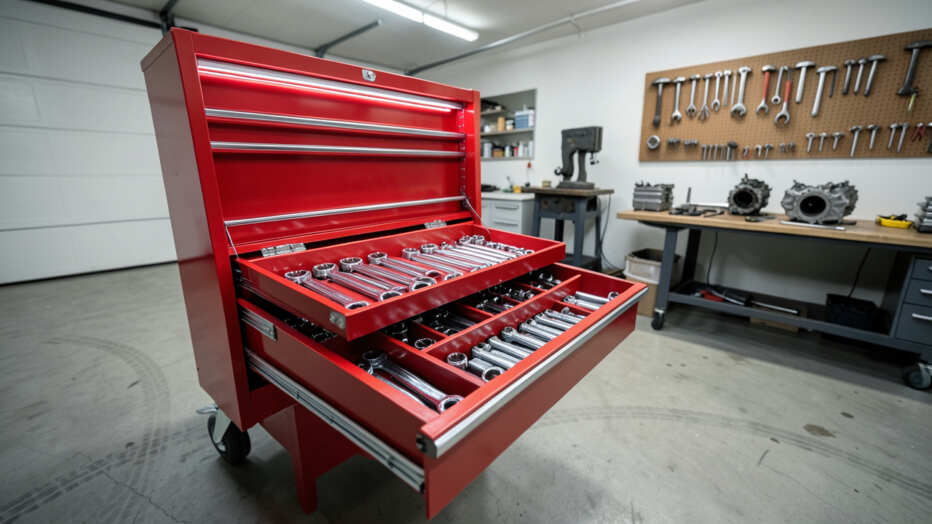
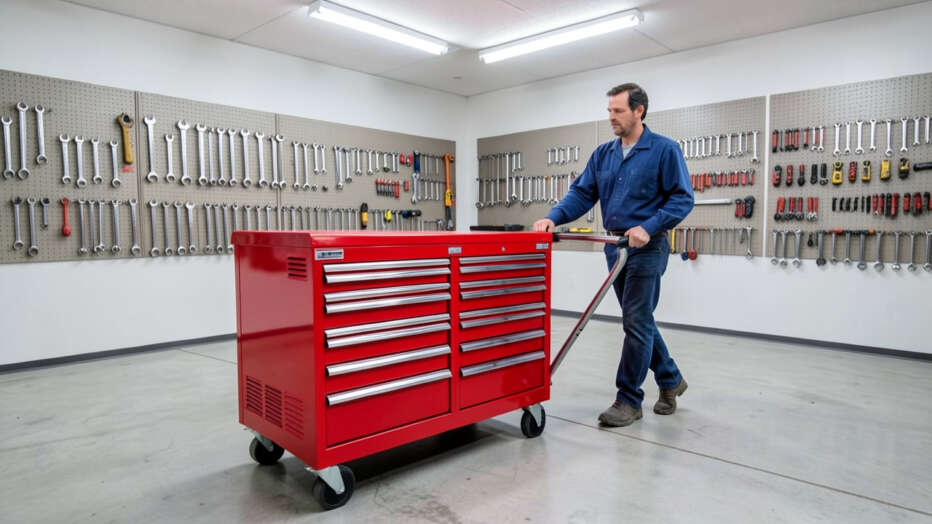
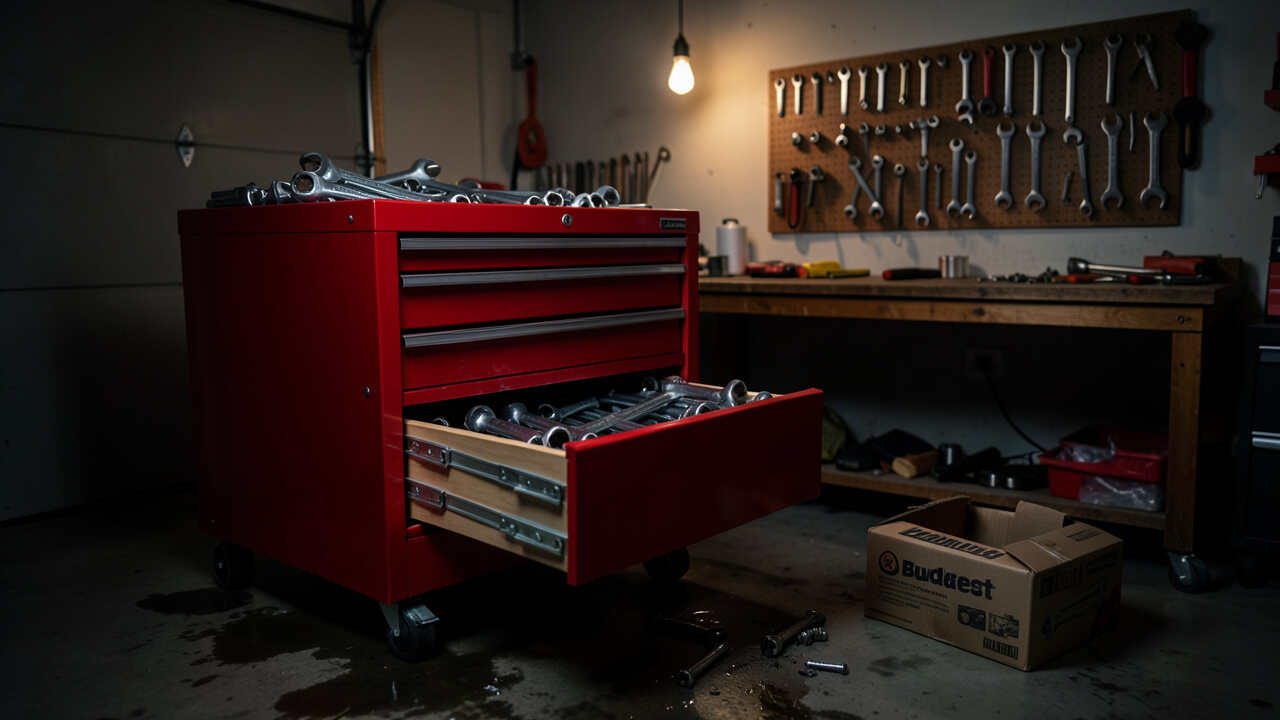
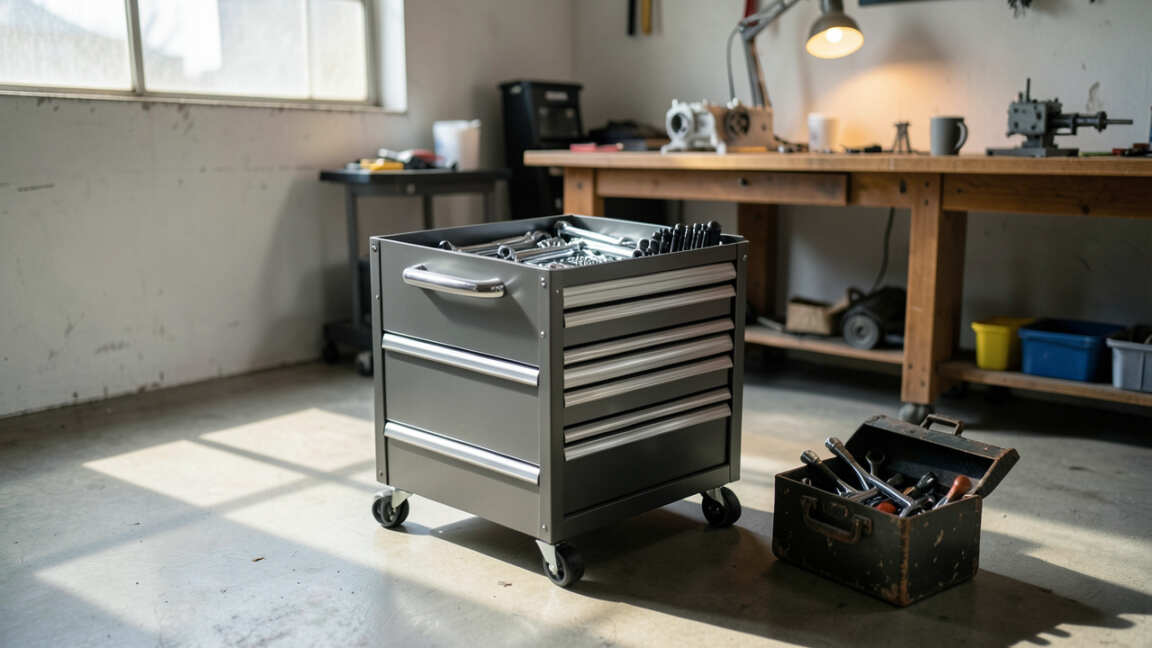
A rolling tool chest is a mobile storage unit designed to hold hand tools, power tools, and accessories on lockable wheels. It typically features a series of drawers, a top work surface, and a central locking mechanism. You load your tools into the drawers, lock the chest, and roll it wherever you need it in your garage or workshop.
The mechanism is simple but effective. Heavy-gauge steel construction provides durability, while ball bearing drawer slides allow smooth operation even under full load. Most units have two fixed casters and two swivel casters with brakes, giving you both stability and maneuverability.
Here are the core components of a typical rolling tool chest:
- Drawer system: Multiple drawers in various depths for different tool sizes
- Caster wheels: Heavy-duty wheels with locking brakes for safe positioning
- Central locking: Single key or latch secures all drawers simultaneously
- Top work surface: Flat steel or laminate top for small repairs or tool placement
- Side handles: Ergonomic handles for pushing and steering the chest
- Drawer liners: Rubber or foam mats to protect tools and reduce noise
- Gauge steel body: 18-gauge to 22-gauge steel depending on quality tier
Tip: Choose a chest with at least two deep drawers for storing power tools like drills and impact wrenches. Shallow drawers work best for sockets, wrenches, and screwdrivers.
What Are the Key Benefits of Using a Rolling Tool Chest?
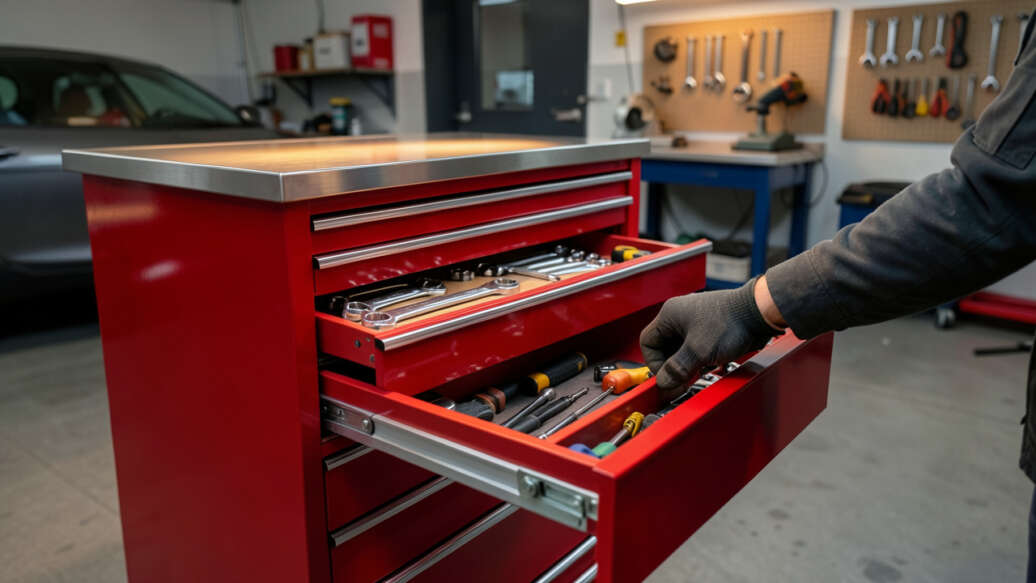
A rolling tool chest does more than just hold tools. It transforms how you work. The American Society of Mechanical Engineers found that organized tool storage can reduce project completion time by up to 30 percent.
That means less time searching and more time building.
The Bureau of Labor Statistics reports that mechanics and technicians spend an average of two and a half hours per week looking for misplaced tools. A rolling chest eliminates that waste almost entirely. Every tool has a dedicated home, and you can see everything at a glance when you open a drawer.
Here are the top benefits ranked by impact:
- Mobility: Roll your entire tool collection from the workbench to the car bay in seconds
- Security: Central locking protects expensive tools from theft and unauthorized use
- Organization: Dedicated drawers prevent tool clutter and reduce loss
- Space efficiency: Vertical storage uses garage floor space more effectively than shelving
- Tool protection: Enclosed storage shields tools from dust, moisture, and impact damage
- Productivity: Faster tool access cuts project time and reduces frustration
- Resale value: Quality chests hold 50 to 70 percent of their value over a decade
The financial argument is strong. A typical homeowner who buys a mid-range chest for around 500 dollars will recoup that investment within two years simply through reduced tool replacement costs and saved labor time. Professional users often see payback in under six months.
| Benefit | Casual Homeowner | Frequent DIYer | Professional User |
|---|---|---|---|
| Time saved per week | 30 minutes | 1 hour | 2+ hours |
| Tool loss reduction | 50% | 70% | 90% |
| Payback period | 3-4 years | 1-2 years | 3-6 months |
| Recommended investment | $200-$400 | $400-$800 | $1,000-$3,000 |
The table above shows how the value of a rolling tool chest scales with your usage intensity. Even casual users see meaningful time savings and reduced tool replacement costs.
How to Choose the Right Rolling Tool Chest for Your Garage
Choosing the right rolling tool chest depends on three factors: the size of your tool collection, the available floor space in your garage, and your budget. A chest that is too small will leave tools scattered, while one that is too large wastes valuable room.
Start by measuring your garage floor space. You need at least two feet of clearance in front of the chest for full drawer extension. Also measure doorways and aisles to ensure the chest can move freely.
The National Association of Home Builders reports that most garages have between 400 and 600 square feet of total space, so efficient storage matters.
Use this checklist to evaluate any chest you are considering:
- Width: 26 inches for entry-level, 41 inches for mid-range, 56 to 72 inches for professional
- Drawer count: Minimum of 6 drawers for basic organization, 12 or more for extensive collections
- Weight capacity: At least 100 pounds per drawer for power tools, 50 pounds for hand tools
- Steel gauge: 18-gauge or thicker for professional use, 20 to 22-gauge for home use
- Caster size: 4-inch casters for smooth rolling, 5-inch for rougher floors
- Locking system: Central locking with a bar mechanism is more reliable than individual drawer locks
- Brand reputation: Snap-on and Matco for pro use, Craftsman and Husky for DIY, Milwaukee for hybrid
Important: Always check the loaded weight of the chest. A fully loaded 56-inch chest can weigh over 500 pounds. Make sure your garage floor can handle the weight and that the casters are rated for the total load.
Price correlates directly with build quality and capacity. Entry-level chests from brands like US General or Craftsman start around 200 dollars and work well for basic homeowner use. Mid-range options from Husky or Milwaukee cost between 400 and 800 dollars and offer better drawer slides and thicker steel.
Professional-grade chests from Snap-on or Matco exceed 2,000 dollars but deliver lifetime durability.
Rolling Tool Chest vs. Stationary Tool Cabinet: Which Is Better?
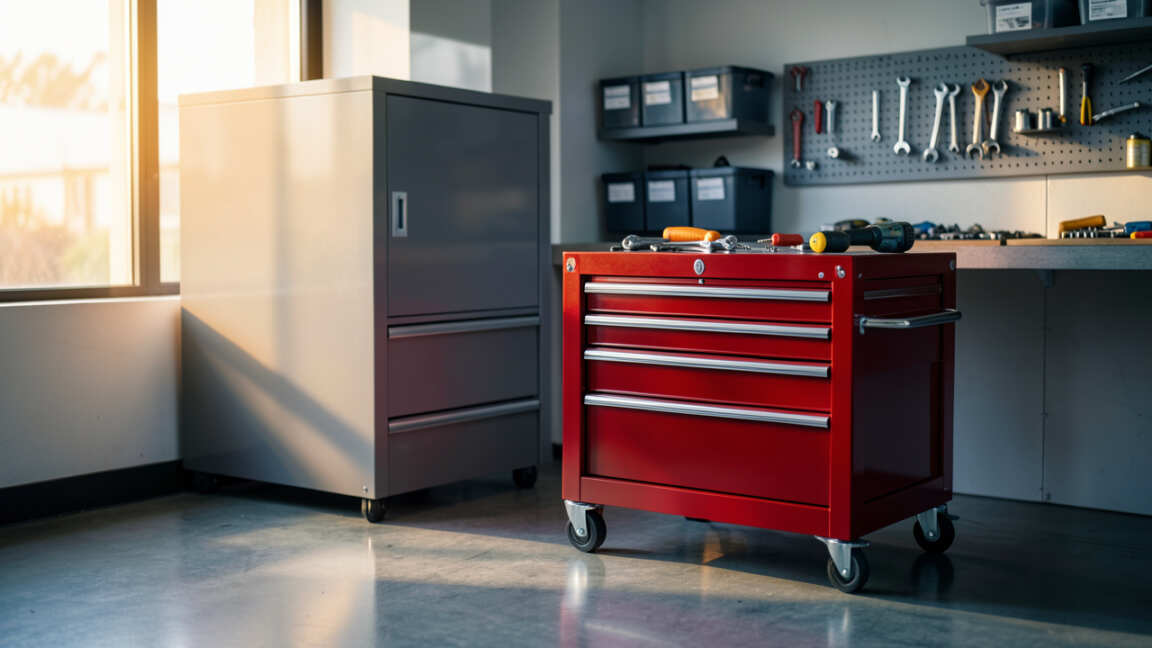
The biggest decision you will make is whether to buy a rolling tool chest or a stationary tool cabinet. Both store tools, but they serve different workflows. A rolling chest prioritizes mobility and flexibility, while a stationary cabinet focuses on maximum capacity and lower cost per cubic foot.
Stationary cabinets are bolted to the wall or floor and cannot move. They are typically cheaper for the same storage volume because they lack casters, handles, and reinforced frames. However, you have to walk to them every time you need a tool.
That adds up over a long project.
A rolling chest brings the tools to you. That is a major advantage in a multi-use garage where you work on cars, woodworking, and home repairs in different zones. Consumer Reports notes that users with mobile chests complete projects 15 percent faster on average than those with stationary storage.
| Feature | Rolling Tool Chest | Stationary Cabinet |
|---|---|---|
| Mobility | Excellent – rolls anywhere | None – fixed in place |
| Storage capacity | Moderate (6-18 drawers) | High (shelves + drawers) |
| Cost per cubic foot | Higher ($15-$30) | Lower ($8-$15) |
| Locking security | Central lock standard | Varies by model |
| Best for | Multi-zone garages, mobile work | Dedicated workshop, large collections |
The choice comes down to your workflow. If you move around your garage while working, a rolling chest is the clear winner. If you always work at the same bench, a stationary cabinet offers more storage for less money.
What Features Should You Look for in a Rolling Tool Chest?
Not all rolling tool chest models are built the same. The features that separate a great chest from a mediocre one are often invisible at first glance. Understanding these details helps you spend money on what actually matters for long-term satisfaction.
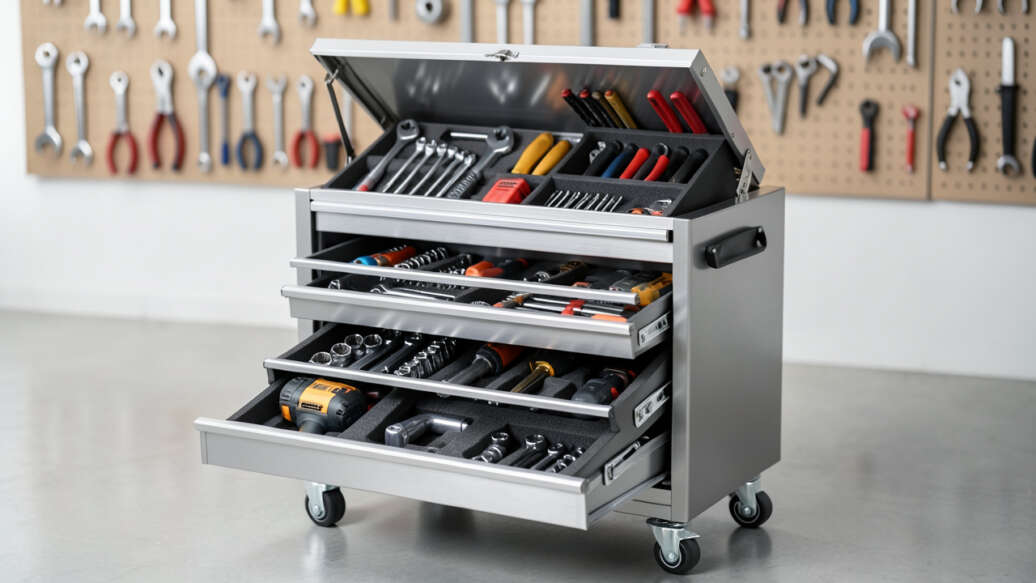
Drawer slides are the most important mechanical component. Ball bearing slides with a weight rating of at least 100 pounds per drawer are essential for power tools. Full-extension slides allow you to access tools at the back of the drawer without reaching blindly.
The best slides are rated for 10,000 cycles or more.
Here are the critical features ranked by importance:
- Ball bearing drawer slides with full extension and at least 100-pound capacity per drawer
- Steel gauge construction – 18-gauge or thicker for durability, powder-coated finish for rust resistance
- Central locking system with a bar mechanism rather than individual key locks on each drawer
- Caster quality – 5-inch dual-lock casters with solid rubber tread for smooth rolling
- Drawer configuration – mix of shallow, medium, and deep drawers to accommodate different tool types
- Top work surface – hardwood or stainless steel top adds utility beyond just storage
- Soft-close mechanism prevents drawer slamming and reduces wear over time
Warning: Avoid chests with plastic drawer slides or friction slides for any drawer that will hold heavy tools. They will fail within months of regular use and cannot be repaired easily.
Additional features worth considering include a power strip on the back for charging batteries, a side shelf that folds down for extra workspace, and interlocking capability that lets you stack a top chest on your rolling cabinet. Many brands offer modular systems that expand over time as your tool collection grows.
Grand View Research reports that the global tool storage market continues to grow at a steady pace, driven by demand for higher-quality materials and better ergonomics. Brands like Milwaukee and DeWalt have introduced chests with stainless steel top plates and integrated USB charging ports, reflecting how the category is evolving.
How to Organize Your Rolling Tool Chest for Maximum Efficiency
Buying a rolling tool chest is only half the battle. How you organize it determines whether you actually save time. A poorly organized chest can be just as frustrating as no chest at all.
The goal is to create a system where you can reach any tool in under ten seconds.
Start by grouping tools by function rather than by size. Put all your wrenches in one drawer, all your sockets in another, and all your screwdrivers in a third. This logic is faster than trying to make tools fit by dimension alone.
The American Society of Mechanical Engineers recommends a zone-based organization system for professional efficiency.
Follow these organization steps in order:
- Step 1: Empty all tools onto a large table and clean them
- Step 2: Sort tools into categories: wrenches, sockets, screwdrivers, pliers, power tools, measuring tools, fasteners
- Step 3: Assign the most-used tools to the middle drawers at waist height for easiest access
- Step 4: Place heavy power tools in bottom drawers to keep the center of gravity low
- Step 5: Use drawer dividers and foam cutouts to prevent tools from shifting when the chest moves
- Step 6: Place rarely used tools in the top or bottom drawers
- Step 7: Label each drawer with a label maker or chalk marker for quick identification
Tip: Use magnetic strips on the inside of the chest lid or side panels to store wrenches and screwdrivers vertically. This frees up drawer space for bulkier items and keeps frequently used tools visible without opening a drawer.
A well-organized chest also reduces tool damage. When tools are properly separated with dividers or foam inserts, they do not knock against each other. Sockets stay organized in rails, wrenches stay paired by size, and drill bits remain in indexed cases.
This level of organization extends the life of your tools significantly.
Review your organization every three months. Your tool collection changes as you buy new items or retire old ones. Adjust drawer assignments to keep high-use tools at waist level and low-use tools in harder-to-reach spots.
An organized chest is a living system, not a static one.
Common Mistakes to Avoid When Buying a Rolling Tool Chest
Many buyers make preventable mistakes when purchasing their first rolling tool chest. These errors lead to wasted money, frustration, and a chest that does not meet your actual needs. Knowing the pitfalls ahead of time saves you from buying twice.
The most common mistake is buying a chest that is too small. People underestimate how many tools they own and how fast a collection grows. A 26-inch chest with six drawers might seem adequate at first, but you will outgrow it within a year if you are an active DIYer or professional.
Here are the top mistakes ranked by frequency:
- Buying too small: Always choose one size larger than you think you need
- Ignoring drawer depth: Shallow drawers cannot hold power tools or long wrenches
- Choosing plastic over steel: Plastic chests crack under heavy loads and do not lock securely
- Overlooking caster quality: Cheap casters jam, wobble, or break on rough garage floors
- Skipping the central lock: Individual locks are tedious and leave drawers unlocked accidentally
- Not measuring clearance: You need room to fully extend drawers without hitting walls or cars
- Prioritizing looks over build: A flashy paint job cannot compensate for thin steel and poor slides
Warning: Never buy a rolling tool chest without testing the drawer slides in person. Open each drawer fully and check for wobble, binding, or uneven extension. Online reviews cannot substitute for hands-on testing of this critical component.
Another frequent error is ignoring the total weight of a fully loaded chest. A 56-inch chest from a brand like Husky or Milwaukee can hold over 2,000 pounds of tools. That weight puts stress on the casters, the floor, and any ramps or thresholds the chest must cross.
Make sure your garage floor is level and that the casters are rated for the actual load you will place in the drawers.
Finally, do not overlook warranty terms. Snap-on offers a lifetime warranty on their chests, while many budget brands only cover defects for one year. The warranty directly reflects the manufacturer’s confidence in the build quality.
A longer warranty is worth paying for on a product you will use weekly for years.
Is a Rolling Tool Chest Worth the Investment?
After evaluating all the factors, the answer is clear. A rolling tool chest is worth buying for anyone who uses tools more than once a month. The combination of mobility, organization, security, and tool protection delivers measurable value that offsets the upfront cost.
For casual homeowners with a small toolbox of basic tools, a rolling chest might be overkill. A simple tool bag or wall pegboard would suffice. But for anyone who owns a drill, a socket set, wrenches, screwdrivers, pliers, and measuring tools, a rolling chest eliminates the daily frustration of digging through cluttered drawers or scattered bags.
Consumer Reports estimates that the average tool owner loses 100 to 200 dollars per year in misplaced or damaged tools. A rolling chest reduces that loss by 70 to 90 percent. Over five years, the savings alone can cover the cost of a mid-range chest.
Add in the time savings and the improved workflow, and the investment becomes a net positive within the first year for frequent users.
The resale market also supports the value. High-quality rolling chests from brands like Snap-on, Matco, and Craftsman retain 50 to 70 percent of their original value after a decade of use. That is far better than most other garage equipment.
If you ever upgrade or change hobbies, you can sell your chest and recoup a significant portion of your investment.
For professionals, the decision is even more straightforward. The Bureau of Labor Statistics data on time spent searching for tools translates directly to lost billable hours. A mechanic or technician earning 50 dollars per hour who saves two hours per week recovers the cost of a 2,000-dollar chest in just 20 weeks.
After that, every hour saved is pure profit.
Frequently Asked Questions
What size rolling tool chest do I need for my garage?
For most homeowners, a 41-inch wide chest with 8 to 12 drawers provides the right balance of capacity and floor space. If you have a professional tool collection or work on vehicles, step up to a 56-inch chest with 14 to 18 drawers. Always measure your garage floor and door clearance before buying.
How much weight can a rolling tool chest hold?
Entry-level chests typically hold 500 to 800 pounds total. Mid-range models hold 1,000 to 1,500 pounds. Professional-grade chests from Snap-on or Matco can hold 2,000 to 3,000 pounds.
Always check the total weight rating and ensure your garage floor can support the loaded chest.
Is it better to buy a rolling tool chest or a tool cabinet with a workbench?
It depends on your workflow. A rolling chest offers mobility and flexibility for multi-zone garages. A stationary cabinet with a workbench provides more storage and a dedicated work surface for less money.
Many users eventually combine both: a rolling chest for mobile tool access and a fixed bench for heavy work.
What is the best brand of rolling tool chest for the money?
Husky and Craftsman offer the best value for homeowners, with solid construction and good warranties at reasonable prices. For professionals, Snap-on and Matco deliver the highest durability but at a premium cost. Milwaukee strikes a good balance between quality and price for serious DIYers and semi-pro users.
How long does a rolling tool chest typically last?
A quality rolling tool chest with ball bearing slides and thick steel construction will last 15 to 20 years with normal use. Entry-level chests with thinner steel and basic slides typically last 5 to 10 years. Proper maintenance, such as lubricating slides and tightening hardware, extends the lifespan significantly.
Final Thoughts
A rolling tool chest is a smart investment for anyone serious about garage organization. It saves time, protects your tools, and keeps your workspace functional. Choose a chest that matches your tool collection and usage frequency, and organize it with a logical system from day one.
The upfront cost pays for itself through reduced tool loss, faster project completion, and daily convenience.