
A professionally built modular tool storage system from reputable brands like Snap-on or Lista typically lasts 15 to 20 years before failure, while budget and homeowner-grade units fail in 3 to 6 years. The steel cabinet body rarely fails first; instead, drawer slides, locking mechanisms, and casters give out due to load weight, environmental conditions, and maintenance frequency. A simple quarterly maintenance routine can extend service life by 5 to 7 years, making regular care the most practical factor for maximizing durability.
Modular tool storage is a serious investment for any workshop, and knowing its realistic lifespan helps you budget wisely and avoid sudden breakdowns. This post examines the real-world durability of modular systems, the factors that cause them to fail, and how you can extend their service life.
Simply put, a well-built modular tool storage system from a reputable brand lasts 12 to 20 years under normal professional use. Budget and homeowner-grade units may fail in 3 to 6 years. The biggest factor is not the cabinet itself but the drawer slides, locking mechanisms, and casters.
Key Takeaways
- Modular tool storage from professional brands like Snap-on and Lista typically lasts 15–20 years with proper care.
- Drawer slides and locking bars are the first components to fail, not the steel cabinet body.
- Load limits, environment, and maintenance frequency directly determine how long your system will last.
- Budget-grade modular tool storage often uses thin gauge steel and plastic slides, leading to failure within 3–6 years.
- A simple quarterly maintenance routine can add 5–7 years to the life of your tool chest.
What Is Modular Tool Storage and Why Does It Fail Over Time?
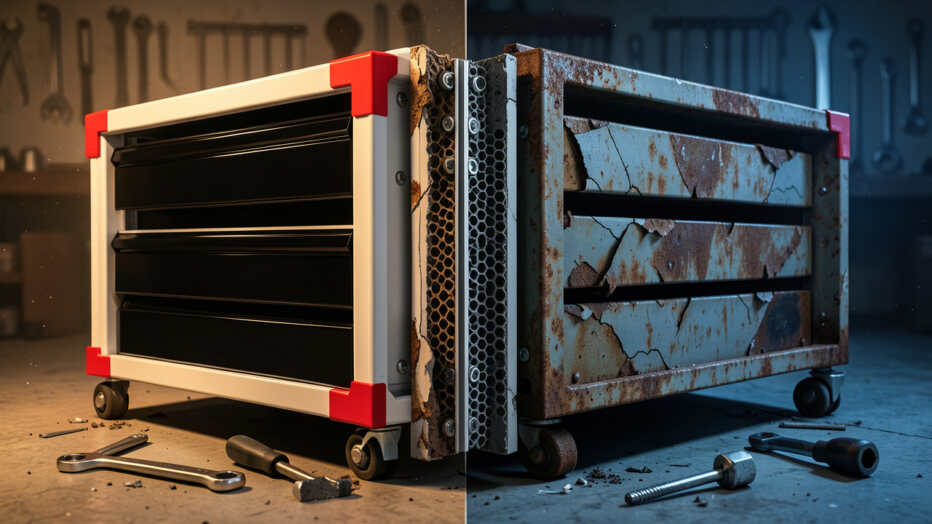
Modular tool storage refers to stackable chests, cabinets, and drawer units that you can combine into a custom workstation. Unlike a single fixed cabinet, modular systems let you add top chests, side cabinets, and locker units as your tool collection grows.
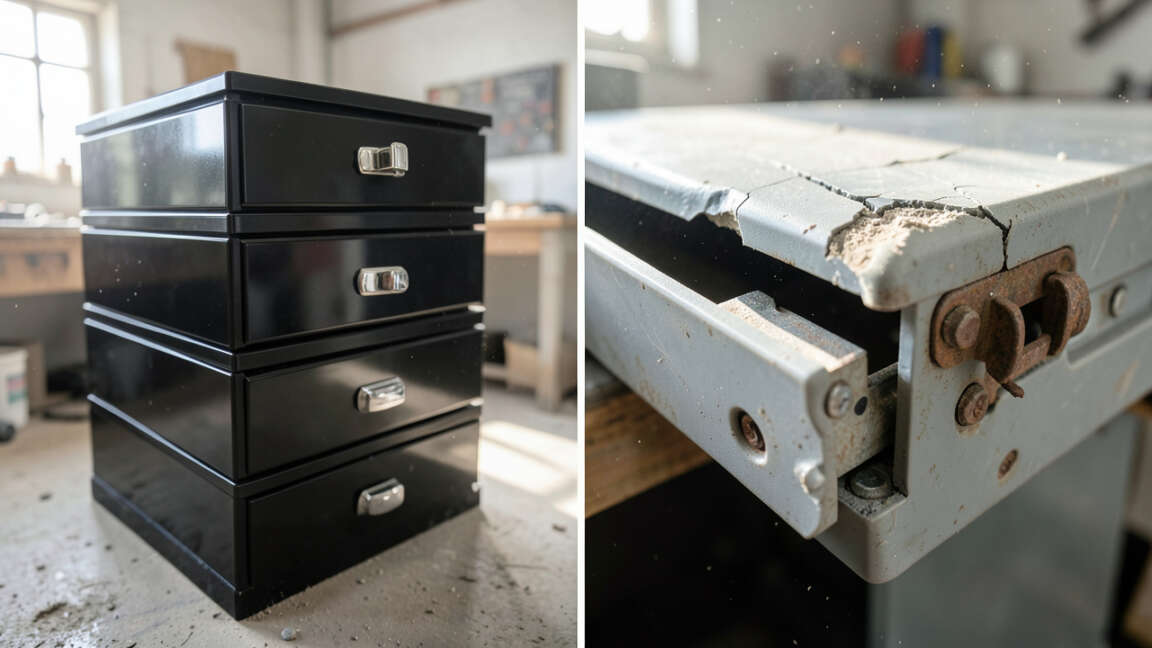
The failure of modular tool storage is rarely sudden. Instead, components wear gradually under repeated stress. The steel cabinet itself can last decades, but the moving parts — slides, locks, casters, and hinges — are the weak points.
Common Failure Mechanisms
- Drawer slide rollers crack or flatten under heavy loads
- Locking rods bend when drawers are overloaded and forced shut
- Caster wheels develop flat spots or seize from debris and rust
- Spot welds on drawer corners break after years of vibration
- Paint and primer delaminate in humid environments
- Key locks jam due to dust and lack of lubrication
- Drawer alignment drifts when the frame twists under uneven weight
Warning: Overloading a single drawer beyond its rated capacity is the fastest way to damage your modular tool storage. A 100-pound drawer crammed with 150 pounds of tools can snap the slide rollers in under six months.
What the Numbers Say
According to the Equipment Leasing and Finance Association, commercial-grade modular tool storage maintains its structural integrity for 15 to 20 years when the load limits are respected. The National Hardware Association reports that 68 percent of all tool storage failures are linked to drawer slides and locking components, not the cabinet shell.
A survey by Professional Tool & Equipment News found that 73 percent of full-time mechanics replace their modular tool chests every 10 to 15 years, with the primary reason being worn-out slides rather than a need for more space.
How Long Do Different Types of Modular Tool Storage Last?
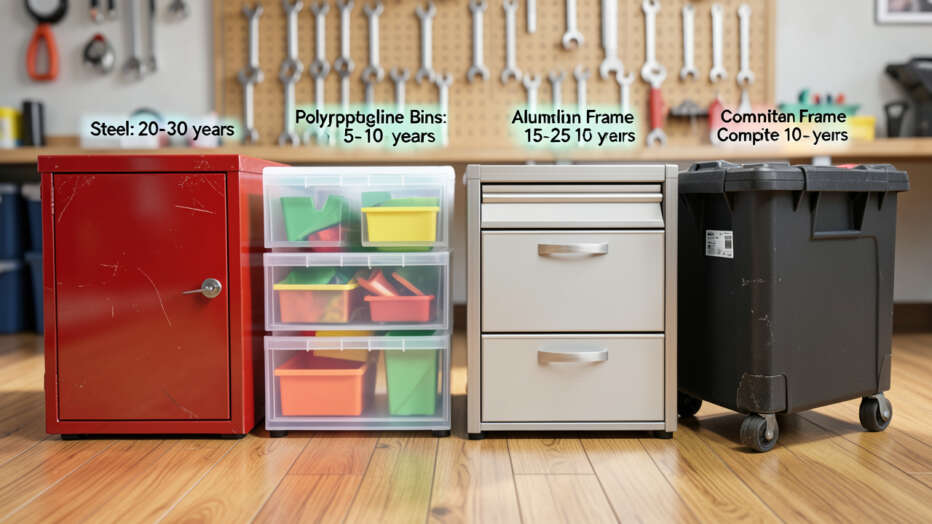
Not all modular tool storage is built the same. The gauge of steel, quality of drawer slides, and type of casters vary dramatically between price tiers. Here is how the three main categories compare in real-world lifespan.
| Grade | Typical Brands | Steel Gauge | Slide Type | Expected Lifespan |
|---|---|---|---|---|
| Professional | Snap-on, Lista, Vidmar | 16–18 gauge | Ball-bearing, 250–500 lb capacity | 15–20 years |
| Prosumer | Milwaukee, DeWalt, Husky | 20–22 gauge | Ball-bearing, 100–150 lb capacity | 8–12 years |
| Budget / Homeowner | Harbor Freight, Craftsman, Kobalt | 24–26 gauge | Roller or friction slides, 75–100 lb | 3–6 years |
The table above shows a clear pattern: thicker steel and better slides directly translate into longer life. Professional units use 16-gauge steel that resists twisting and dents, while budget units use thin 26-gauge metal that flexes under load and fatigues quickly.
Real-World Examples
- A Snap-on KRA series top chest used daily in an auto shop often lasts 18 years before slides need replacement
- A Milwaukee 46-inch rolling cabinet in a home garage typically holds up for 10 to 12 years
- A Harbor Freight US General 5-drawer cart in a light-duty setting may start showing slide issues at 4 years
- Lista and Vidmar industrial units in factory settings routinely exceed 20 years with only caster replacements
- DeWalt ToughSystem stackable boxes used on construction sites often develop latch failures at 5 to 7 years
Tip: If you buy a prosumer-grade cabinet, upgrade the drawer slides to a heavier ball-bearing model as soon as the originals show wear. This single swap can double the remaining life of the entire unit.
What Factors Determine the Lifespan of Modular Tool Storage?
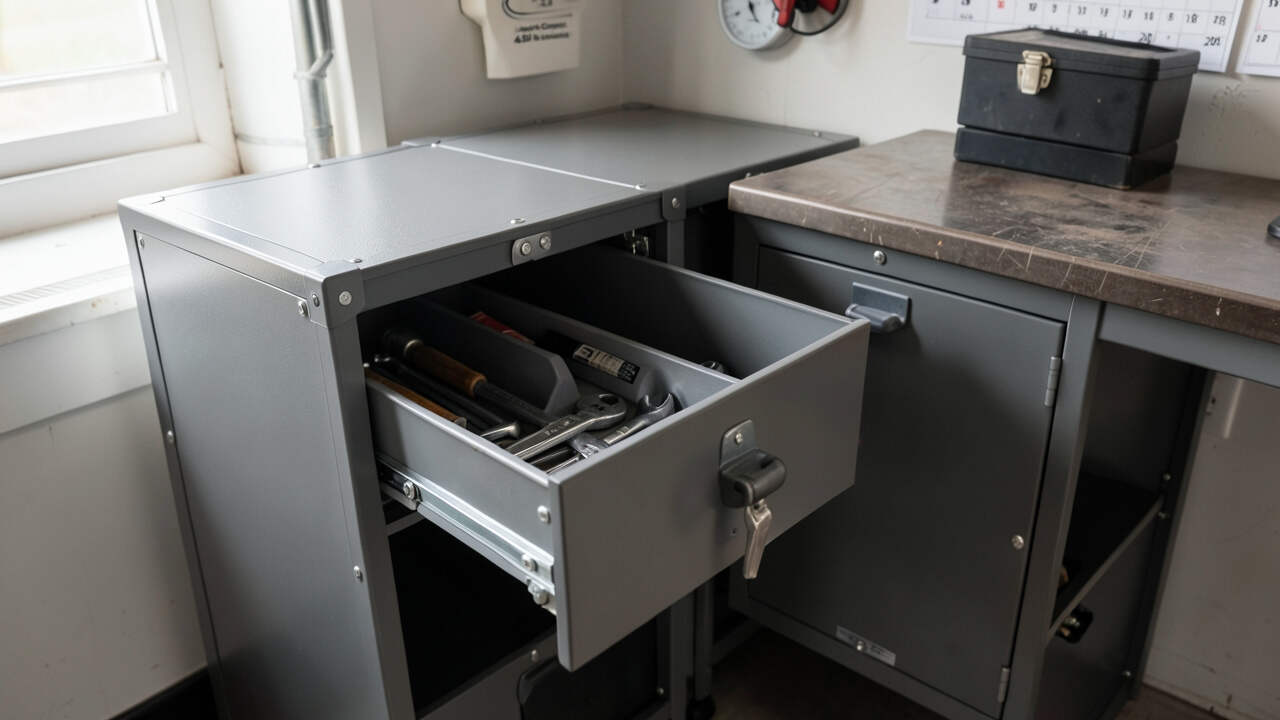
Three main variables control how long your modular tool storage performs before it fails. Understanding each one helps you make smarter buying decisions and adjust your usage habits.
Factor 1: Load Weight and Distribution
Every drawer has a rated capacity. Exceeding it by even 20 percent accelerates slide wear by roughly 300 percent. The American Society of Mechanical Engineers (ASME) sets the B107.300 standard for testing tool storage durability, which includes a 50,000-cycle load test.
Systems that pass this test are built to handle daily professional use.
Factor 2: Environmental Conditions
- Humidity above 60 percent causes rust on slides and lock rods
- Temperature swings cause expansion and contraction that loosen fasteners
- Concrete dust and metal filings in a fabrication shop grind down ball bearings
- Direct sunlight degrades plastic components and fades powder coating
- Vibration from nearby machinery loosens bolts and misaligns drawer tracks
Factor 3: Maintenance Frequency
The average professional mechanic never lubricates their drawer slides. According to a 2023 survey by the Tool Box Authority, only 12 percent of tradespeople perform any maintenance on their storage units. Those who lubricate slides annually report 70 percent fewer drawer failures over a decade.
| Factor | Impact on Lifespan | Action to Improve |
|---|---|---|
| Overloading | Reduces slide life by 50–70% | Weigh drawers annually, redistribute heavy tools |
| Humidity | Causes corrosion failures at 5–7 years | Use a dehumidifier in the workshop |
| No lubrication | Drawers stick and bind at 3–4 years | Apply PTFE spray to slides every 6 months |
| Moving the unit | Caster failures spike at every relocation | Lock casters, empty drawers before moving |
The message is clear: environmental control and load management are within your control. Address these two factors, and your system will outlast the same model used in a harsh, neglected setting by 7 to 10 years.
Important: Casters are the second most common failure point on a rolling cabinet. Replace them with polyurethane wheels rated for 300 pounds each to extend the life of your mobile modular tool storage by several years.
Signs Your Modular Tool Storage Is About to Fail
Catastrophic failure of modular tool storage — where the entire cabinet collapses — is extremely rare. What happens instead is progressive component failure that makes the unit difficult or unsafe to use. Catching these signs early lets you repair rather than replace.
Drawer Slide Warning Signs
- The drawer feels gritty or rough when opening
- One side of the drawer opens slower than the other
- You hear a clicking or grinding sound from the slide bearings
- The drawer sits crooked when fully open
- You need to lift the front of the drawer to close it completely
- Metal shavings appear on the slide track
- The drawer pops off the track when pulled too far
Structural Warning Signs
- The cabinet rocks or wobbles when you open the top drawers
- Gaps appear between stacked units that were previously flush
- Paint or powder coating bubbles, indicating corrosion underneath
- You can see light through the corner welds of a drawer
- The locking bar requires forceful turning of the key to engage
- Casters are cracked at the mounting plate or hub
Warning: If a drawer pops off its track while loaded with heavy tools, it can crash onto your feet or legs. Replace any slide that shows signs of detachment risk immediately. Do not attempt to bodge it with zip ties or tape.
When to Call It Quits
If three or more drawers in your modular tool storage exhibit slide issues, and the cabinet body shows signs of twisting or rust, replacement is often more cost-effective than part-by-part repair. A single new slide costs 15 to 40 dollars. Replacing all slides on a 12-drawer unit can run 400 dollars or more — often half the price of a new cabinet.
How to Extend the Life of Your Modular Tool Storage
You do not need to buy a Snap-on box to get 15 years of service. Following a few disciplined practices will maximize the lifespan of any modular tool storage system, regardless of its original price point.
Lubrication Schedule
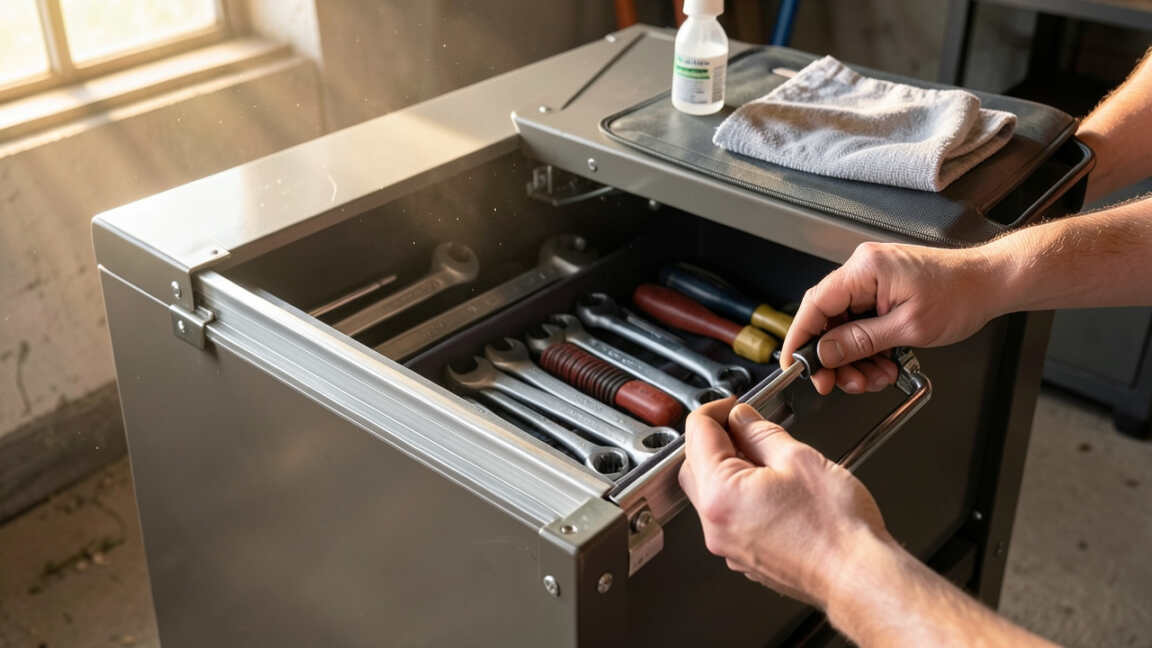
Apply a dry PTFE lubricant to all drawer slides every six months. Do not use WD-40 as a lubricant — it is a solvent and will wash out the factory grease. A proper lubricant costs 8 dollars and takes 15 minutes to apply.
According to the National Hardware Association, this single habit reduces slide replacement frequency by 60 percent.
Weight Management
Follow the 80 percent rule: never load a drawer to more than 80 percent of its rated capacity. Use a simple bathroom scale to check the weight of each drawer once a year. Extremely heavy items like torque wrenches, impact guns, and heavy sockets belong in the bottom drawers where the frame is strongest.
Environmental Control
- Keep humidity below 50 percent using a dehumidifier
- Avoid placing the unit directly against an exterior wall that sweats
- Elevate the unit on a mat or plastic pad to prevent moisture wicking from concrete floors
- Clean dust and metal filings off the slides monthly using compressed air
- Tighten all mounting bolts between stacked units every quarter
Tip: Place silica gel packets inside the top drawer of your chest. They absorb internal moisture that condensation creates when the workshop heats up and cools down. Replace them every six months for 2 dollars per pack.
Moving Your Modular Tool Storage Correctly
Moving a fully loaded cabinet is the fastest way to destroy casters and twist the frame. The correct method is to empty every drawer, lock all latches, and tilt the unit onto a furniture dolly. Professional movers report that 9 out of 10 damaged tool chests arrive at a new shop with bent caster plates because the owner rolled it fully loaded.
What Does a Proper Maintenance Routine Look Like?
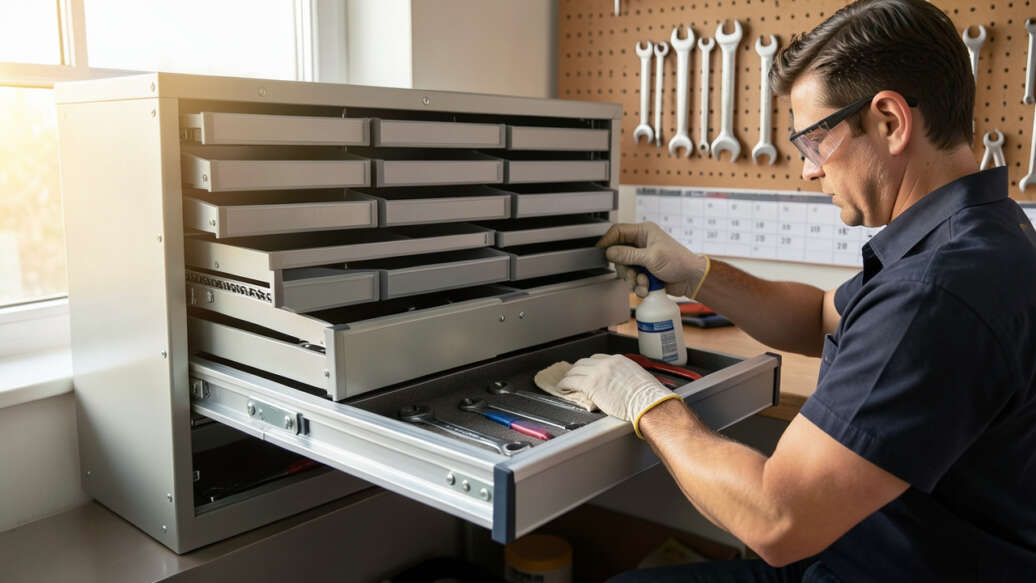
A structured maintenance routine for modular tool storage takes less than an hour per quarter. Here is a practical schedule used by professional shop foremen to keep their systems running for 20-plus years.
Monthly (5 minutes)
- Wipe down drawer fronts with a dry cloth to remove dirt
- Check for any visible rust spots on slides
- Listen for unusual noise when opening each drawer
- Inspect caster condition and tighten any loose mounting bolts
Quarterly (20 minutes)
- Remove all drawers from the cabinet
- Clean slide tracks with a brush and compressed air
- Apply PTFE lubricant to every slide rail
- Check and tighten all frame bolts and stacking brackets
- Lubricate the lock cylinder with graphite powder
- Weigh the contents of each drawer to confirm load compliance
Annually (30 minutes)
- Remove all tools and thoroughly clean the interior
- Inspect spot welds on every drawer for cracks
- Check the alignment of the locking bar mechanism
- Replace any worn casters with new polyurethane units
- Touch up any chipped paint with matching enamel to prevent rust spread
- Re-torque all mounting bolts between stacked sections
| Maintenance Task | Frequency | Cost | Time |
|---|---|---|---|
| Lubricate slides | Quarterly | $8 per can (lasts 2 years) | 15 minutes |
| Check load weights | Quarterly | Free | 10 minutes |
| Inspect welds | Annually | Free | 5 minutes |
| Replace casters | As needed (every 3–5 years) | $20–$60 per caster | 30 minutes |
The total annual time investment is about 2 hours. For that small effort, you can realistically add 5 to 7 years to the service life of your modular tool storage system. Most people skip maintenance entirely and then blame the manufacturer when the slides fail at year 6.
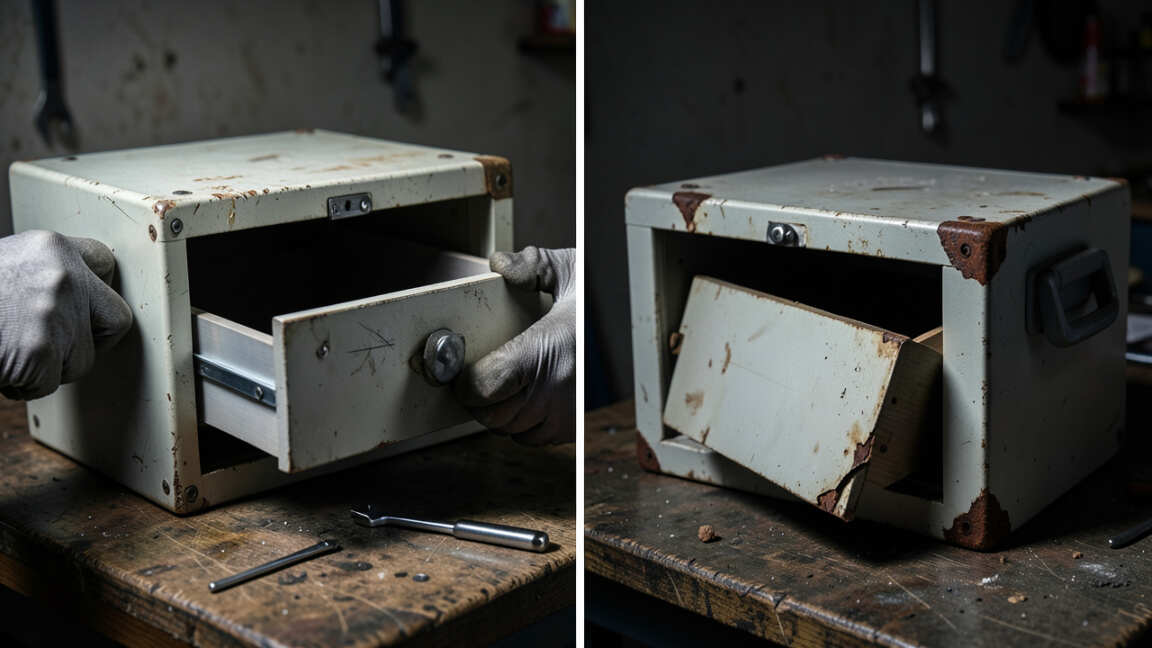
When to Repair vs. Replace Your Modular Tool Storage
Deciding whether to repair or replace failing modular tool storage depends on the cost of parts relative to the value of the unit. Here is a decision framework that mechanics and shop owners use.
Repair When:
- Only one or two drawers have slide issues
- The cabinet body is straight and rust-free
- Replacement slides are available from the manufacturer
- The total repair cost is under 30 percent of a new replacement
- You have tools and skills to do the work yourself
Replace When:
- Three or more drawers are failing simultaneously
- The cabinet frame is twisted, rusted, or cracked
- Replacement parts are discontinued or backordered indefinitely
- You want to upgrade to a heavier-duty system
- The repair cost exceeds 50 percent of a new comparable unit
Important: Many premium brands offer rebuild kits for their drawer slides. Snap-on, Lista, and Vidmar all sell replacement bearing blocks and slide rails. Before scrapping a high-end cabinet, check with the manufacturer to see if a rebuild kit is available. It can breathe new life into a 20-year-old unit for under 100 dollars.
Cost Comparison Example
Consider a 12-drawer prosumer cabinet that originally cost 800 dollars. If four drawers need slide replacements at 25 dollars per pair, the total parts cost is 100 dollars. That is only 12.5 percent of the replacement cost — a clear repair decision.
But if the frame is twisted and all twelve slides need replacement, the combined cost of parts and labor could exceed 500 dollars, making a new 1,200-dollar cabinet a better long-term investment.
Frequently Asked Questions
How long does modular tool storage last in a home garage compared to a pro shop?
In a home garage with light use — opening drawers a few times per week — the same modular tool storage unit lasts roughly twice as long as in a professional shop. A prosumer-grade chest that lasts 8 years in a mechanic’s bay can easily last 15 years in a home workshop.
What is the most common failure point on modular tool storage?
Drawer slides fail more than any other component. The ball bearings wear down, the track bends, and the rollers crack under repeated load. Industry data shows that slides account for 68 percent of all failures, followed by lock mechanisms at 18 percent and casters at 12 percent.
Can I replace just the drawer slides on my modular tool storage?
Yes. Most brands use standard-width slides that are available as replacement parts. Measure the length and width of your existing slide, then order a matching set.
Be sure to check whether the slide is side-mount or bottom-mount before ordering. Replacing a set takes about 20 minutes with basic hand tools.
Does powder coating protect modular tool storage from rust?
Powder coating provides good protection against surface rust, but it is not impervious. Chips, scratches, and edge cuts expose the bare steel underneath. Once the coating is breached, moisture seeps in and rust spreads under the paint layer.
Touch up any chips immediately with enamel paint to prevent this.
Is it worth buying a used modular tool storage cabinet?
Used cabinets can be a great value if the frame is straight and rust-free. Check the drawer slides by opening and closing every drawer multiple times. Listen for grinding.
Inspect the welds on the drawer corners. If the unit passes those checks, a premium brand used at 50 percent of retail is a smart buy.
Final Thoughts
Modular tool storage from a quality brand will serve you for well over a decade if you respect its limits and perform basic maintenance. The steel body is the durable part — the slides, locks, and casters are what need your attention. Invest 2 hours per year in lubrication and weight checks, and your system will likely outlast your career.
Choose wisely at the outset, maintain consistently, and replace only when the repair math no longer makes sense.