
Using a bench grinder in a garage introduces significant safety risks, including fire ignition from sparks that can travel up to 10 feet, exposure to fine metal and abrasive dust that may cause chronic lung damage, and hazardous noise levels. To prevent these dangers, the garage must be equipped with fire-resistant surfaces, proper ventilation or dust collection, and spark deflection barriers to contain debris and hot particles. Essential personal protective equipment, such as impact-rated eye protection, hearing protection, and a respirator, along with routine inspection of the grinder wheel, are critical for safe operation in an enclosed space.
Using a bench grinder in a garage creates serious safety hazards, including fire risks from sparks, toxic dust exposure, and potential wheel failure. This post explains exactly what happens when you run a bench grinder in an enclosed garage and how to protect yourself and your property.
Simply put, a bench grinder in a garage produces hot sparks, fine metal dust, and loud noise that can ignite combustibles, damage lungs, and disturb neighbors. Without proper ventilation, spark deflection, and dust control, you risk fire, respiratory illness, and tool damage.
Key Takeaways
- Using a bench grinder in a garage without ventilation exposes you to fine metal and abrasive dust that can cause lung damage over time.
- Hot sparks from a bench grinder can travel up to 10 feet and ignite gasoline, solvents, sawdust, and other garage combustibles.
- Proper PPE and garage setup — including fire-resistant surfaces, dust collection, and eye protection — are essential for safe operation.
- Noise levels from a bench grinder often exceed 90 dB, which can cause hearing damage with prolonged exposure.
What Happens to Air Quality When You Use a Bench Grinder in a Garage?
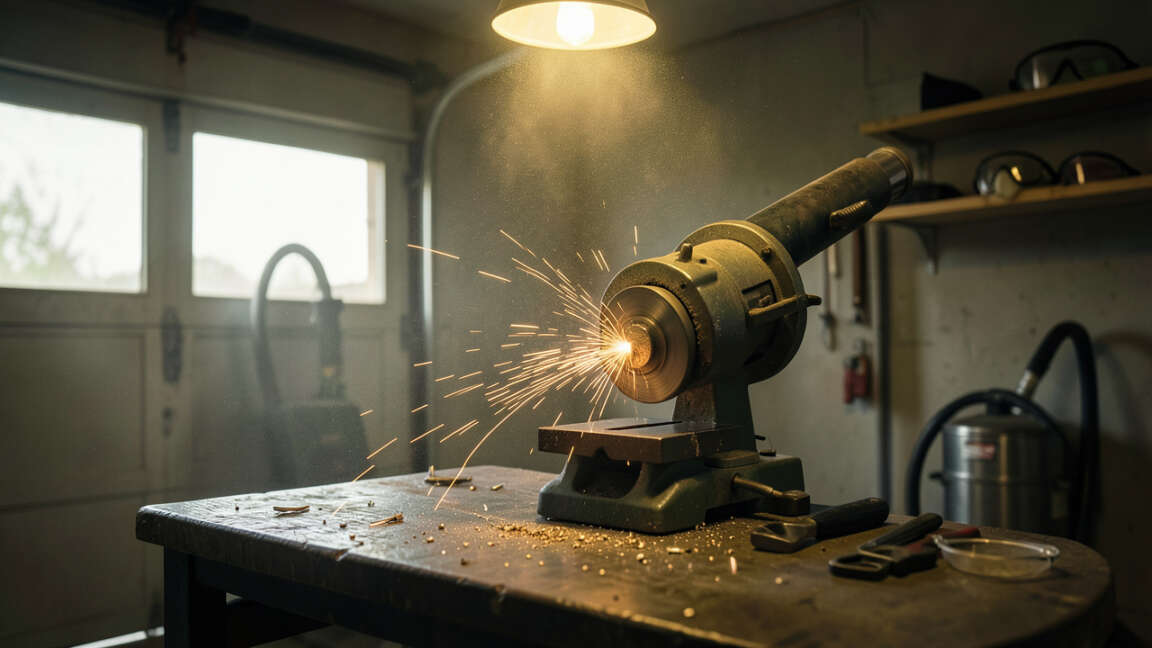
When you use a bench grinder in a garage, the grinding wheel throws off microscopic metal particles and abrasive grit. These particles are small enough to stay suspended in the air for hours. In an enclosed garage, this dust accumulates quickly and does not disperse naturally.
The biggest concern is respirable particulate matter. Particles smaller than 10 microns bypass your nose’s natural filtration and settle deep in your lungs. Over time, this can lead to conditions like siderosis — also known as welder’s lung — or chronic bronchitis.
Warning: According to the CDC, exposure to fine metal dust without proper respiratory protection increases the risk of occupational lung disease. Even short sessions in a closed garage can produce hazardous particle concentrations.
What Types of Dust Does a Bench Grinder Produce?
- Metal filings — fine shavings from steel, iron, aluminum, or brass workpieces
- Abrasive grit — tiny particles shed from the grinding wheel itself
- Oxide particles — created when hot metal reacts with oxygen during grinding
- Resin and binder dust — from composite or vitrified grinding wheels
- Contaminant aerosols — if you grind painted, coated, or greasy materials
The garage environment makes matters worse. Unlike an open workshop, a garage typically has limited airflow. Many garages lack windows that open or have doors that stay closed during winter months.
Without active ventilation, particle concentration rises with every minute of grinding.
Important: The OSHA permissible exposure limit for respirable dust containing metal is 5 mg/m³ over an 8-hour shift. A single 10-minute grinding session in a small garage can spike levels far above this threshold.
Fire and Spark Risks from a Bench Grinder in a Garage
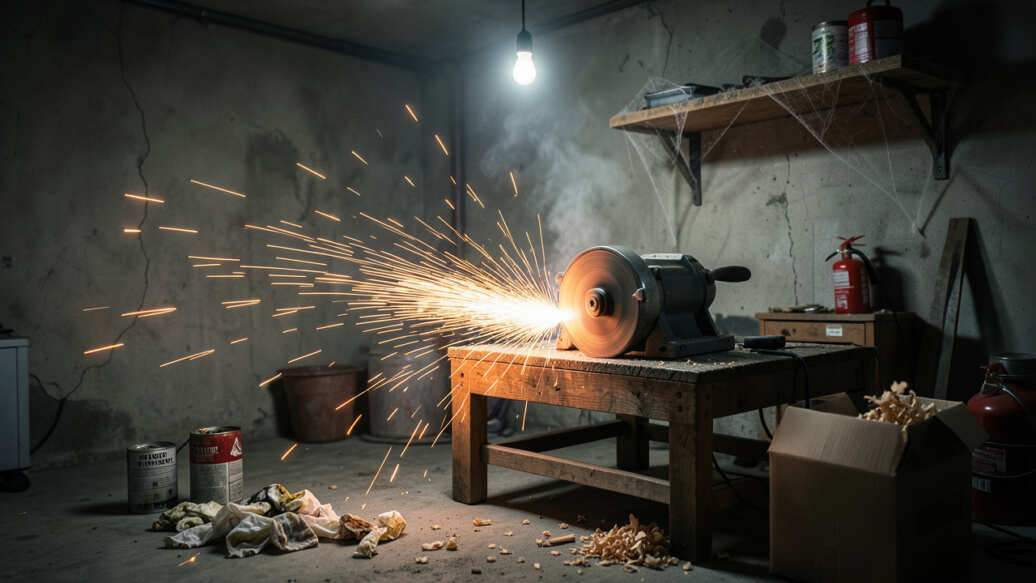
Sparks from a bench grinder are not just a nuisance — they are a genuine ignition source. When the grinding wheel contacts metal, it creates a stream of hot particles that can reach temperatures above 1,000°F. In a garage filled with flammable materials, this is a recipe for disaster.
The National Fire Protection Association (NFPA) reports that approximately 15% of garage fires start from sparks generated by tools and equipment. Gasoline, paint thinners, propane tanks, sawdust, cardboard boxes, and oily rags are all common garage items that ignite easily when exposed to hot sparks.
| Garage Item | Ignition Temperature | Risk Level with Bench Grinder Sparks |
|---|---|---|
| Gasoline vapors | 495°F (257°C) | High |
| Sawdust | 400-500°F | High |
| Cardboard | 465°F (240°C) | Moderate |
| Oily rags | Self-heating at 120°F | Moderate-High |
| Propane tank | 920°F (493°C) | High (explosion risk) |
| Paint thinner | 445°F (229°C) | High |
As the table shows, most common garage items ignite well below the temperature of bench grinder sparks. Even if a spark does not immediately cause a flame, it can smolder in sawdust or cardboard for several minutes before erupting into a fire.
How Far Can Bench Grinder Sparks Travel?
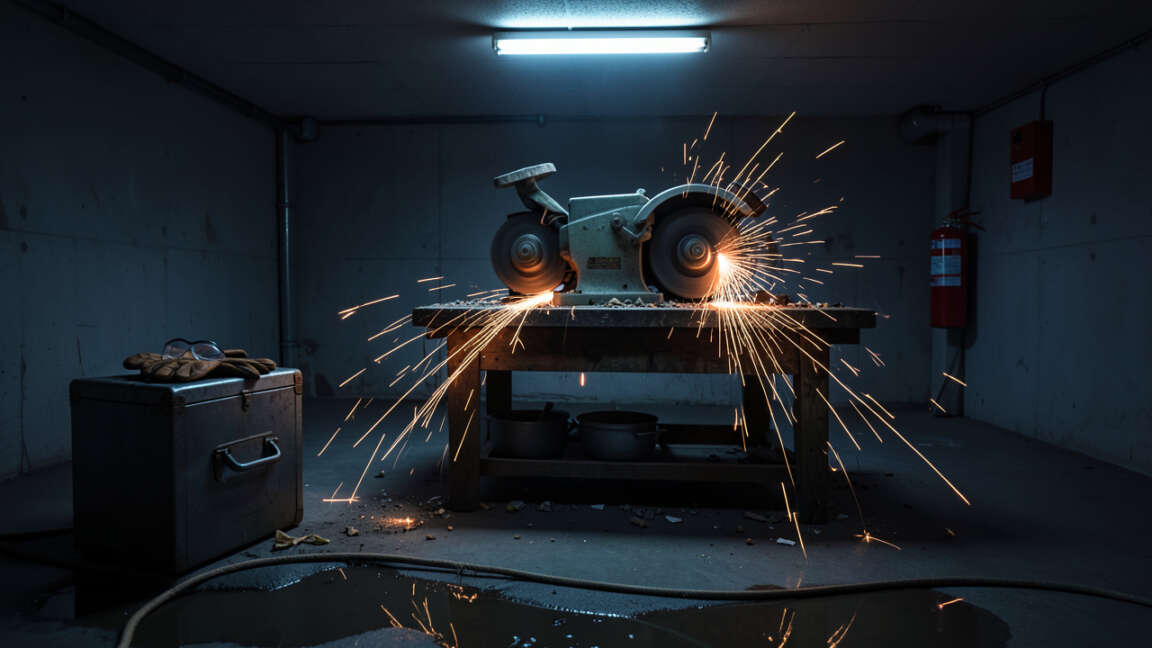
Sparks from a bench grinder can shoot horizontally up to 10 feet and bounce off walls and floors. In a typical two-car garage, that means sparks can reach almost any corner of the space. If you store flammable liquids or combustible materials within that radius, you are playing with fire.
- Sparks exit the grinding wheel at high velocity — up to 6,000 surface feet per minute.
- They bounce off concrete floors and metal workbenches, changing direction unpredictably.
- Sparks can land in cracks, under shelving units, or inside open containers.
- Some sparks remain hot for 2-5 seconds after landing — long enough to ignite fine combustibles.
Warning: Never use a bench grinder near open containers of gasoline, kerosene, or solvents. Move all flammable materials to a separate storage area or at least 15 feet away from the grinding station.
How Noise Affects Your Garage Work Environment
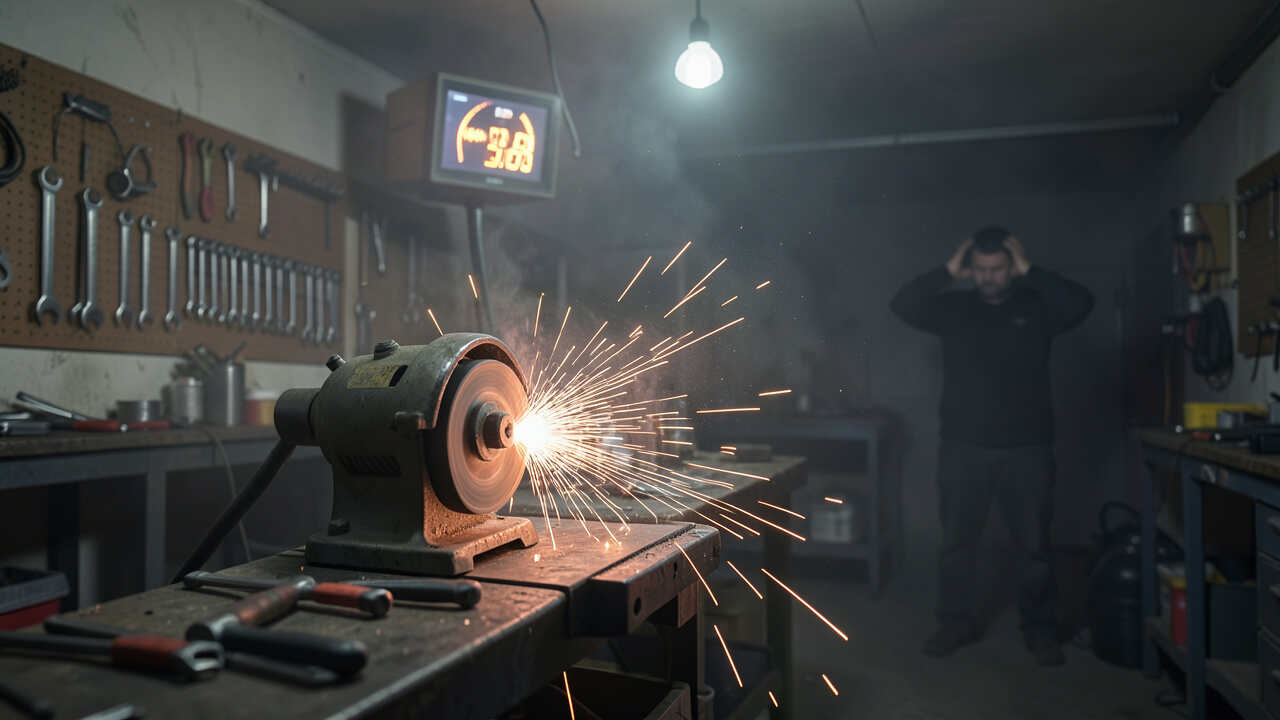
A bench grinder in a garage produces noise levels between 85 and 105 decibels, depending on the wheel type, motor power, and workpiece material. That is louder than a lawnmower and comparable to a chainsaw. In an enclosed garage, the sound reflects off concrete walls and amplifies further.
The American Conference of Governmental Industrial Hygienists (ACGIH) recommends a maximum exposure of 8 hours at 85 dB and only 15 minutes at 100 dB. A typical grinding session of 30-45 minutes at 95 dB already exceeds safe noise exposure limits without hearing protection.
Health Effects of Prolonged Grinder Noise
- Temporary hearing loss — ringing in the ears after a grinding session is a sign of cochlear damage
- Permanent noise-induced hearing loss — cumulative damage from repeated exposure without ear protection
- Tinnitus — chronic ringing or buzzing in the ears that can become permanent
- Increased stress and fatigue — loud noise elevates cortisol levels and reduces concentration
- Disturbed neighbors — garage grinders can be heard inside adjacent homes, especially in attached garages
Tip: Use both earplugs and earmuffs for double protection when grinding in a garage. The combination adds about 10 dB of additional noise reduction compared to using either alone.
Noise is not just a health issue — it is also a safety issue. When you cannot hear clearly, you are more likely to miss warning sounds like a grinding wheel cracking, a workpiece slipping, or someone calling out a hazard. Reduced situational awareness increases the chance of accidents.
The Dangers of Dust and Debris Buildup
Fine metal and abrasive dust does not just stay in the air — it settles on every surface in your garage. Over time, a thin layer of conductive metal dust coats your tools, workbench, electrical outlets, and vehicle surfaces. This creates several hidden dangers.
Metal dust is conductive. When it builds up inside electrical outlets, power strips, or motor housings, it can create short circuits or cause arcing. Arcing in a dust-laden environment is a known ignition source for fires.
According to OSHA, combustible dust explosions — while more common in industrial settings — can also occur in garage workshops with heavy metal dust accumulation.
| Dust Type | Conductivity | Risk to Electronics | Cleanup Difficulty |
|---|---|---|---|
| Steel dust | High | High | Moderate (magnetic) |
| Aluminum dust | Medium | Moderate | Hard (non-magnetic) |
| Abrasive grit | Low | Low | Hard (abrasive surface) |
| Mixed dust | Variable | Moderate-High | Hard |
Dust buildup also damages your tools. Abrasive grit that settles on moving parts acts like sandpaper, wearing down bearings, slides, and hinges. Metal dust can corrode surfaces when combined with garage humidity, leading to rust and pitting on expensive equipment.
Important: Vacuum your garage floor and work surfaces after every grinding session. Use a HEPA-filtered shop vacuum — standard shop vacs blow fine dust back into the air instead of trapping it.
How to Safely Operate a Bench Grinder in a Garage
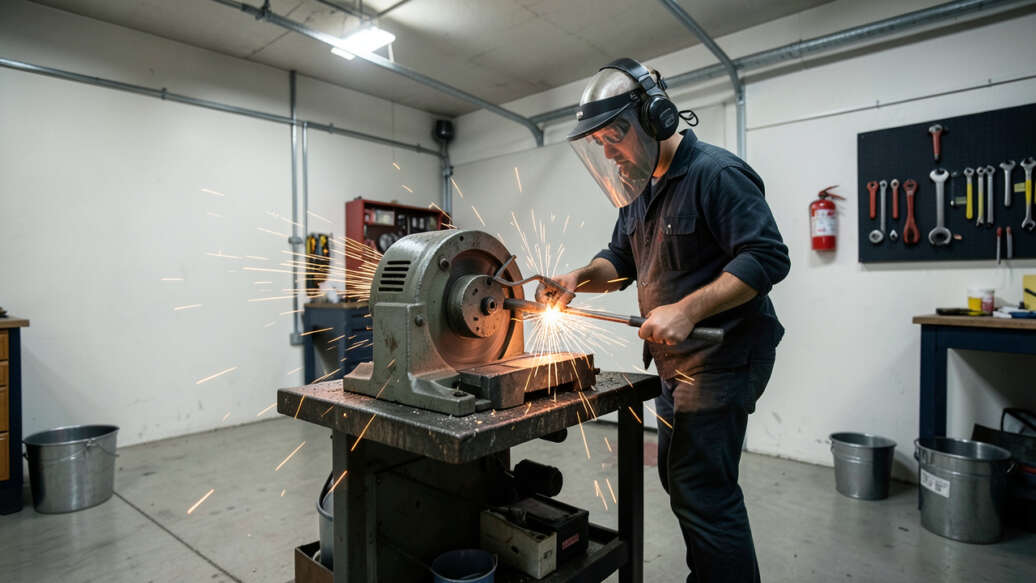
You can use a bench grinder in a garage safely, but it requires deliberate preparation. The key is controlling sparks, dust, and airflow before you start grinding. Here is a step-by-step approach to setting up your garage for bench grinder safety.
- Choose the right location — mount the grinder on a stable, fire-resistant workbench away from flammable storage. Keep at least 15 feet of clearance around the grinding area.
- Install a spark deflector — use a metal or fire-resistant shield behind and around the grinding wheel to direct sparks downward instead of sideways.
- Set up dust collection — place a HEPA shop vacuum nozzle within 6 inches of the grinding zone. Some grinders have built-in dust ports; use them.
- Open garage door or windows — cross-ventilation is the simplest way to reduce airborne particle concentration. Use a fan positioned to blow air across the grinding area toward an exit.
- Remove all combustibles — clear the area of paper, cardboard, rags, solvents, gas cans, and sawdust before grinding.
- Keep a fire extinguisher nearby — mount a Class A-B-C extinguisher within 10 feet of the grinder. Check the pressure gauge monthly.
- Wear full PPE — safety glasses with side shields, face shield, hearing protection, respirator (N95 or better), and fire-resistant gloves. No loose clothing.
Tip: Spring for a bench grinder with a built-in LED light. Better visibility means you can see the spark stream clearly and position your body out of its path. It also helps you spot dust accumulation on nearby surfaces.
What Personal Protective Equipment Do You Need?
- ANSI Z87.1 rated safety glasses — impact-resistant with side shields to catch flying debris
- Full-face shield — protects your face and neck from hot sparks and wheel fragments
- N95 or P100 respirator — fine metal dust requires at least an N95 rating; P100 is better for heavy use
- Hearing protection — earplugs rated NRR 32 dB or higher, or earmuffs with NRR 25 dB or higher
- Leather or fire-resistant gloves — no synthetic materials that can melt onto your skin
- Long sleeves and closed-toe shoes — cotton or denim, not synthetic fabrics that burn easily
Common Mistakes When Using a Bench Grinder in a Garage
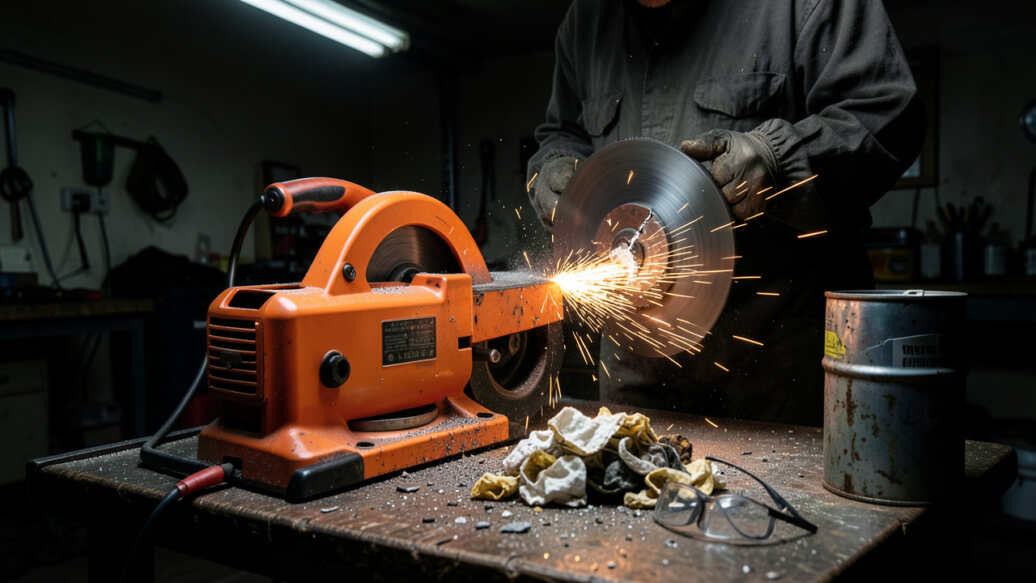
Even experienced DIYers make errors when running a bench grinder in a garage. These mistakes increase risk significantly and are easy to overlook. Here are the most common ones you need to avoid.
Mistake 1: Grinding Aluminum Without Precautions
Aluminum dust is highly reactive. When fine aluminum particles mix with oxygen and a spark, they can ignite explosively. Never grind aluminum on a wheel that has been used for steel — the embedded steel particles create sparks that ignite the aluminum dust.
Dedicate a separate wheel for aluminum grinding.
Mistake 2: Using a Worn or Damaged Grinding Wheel
An ANSI B7.1 compliant wheel should be ring-tested before each use. If the wheel sounds dull or dead when tapped, it may have a hairline crack. A cracked wheel can shatter at high speed, sending fragments across the garage at lethal velocity.
Mistake 3: Mounting the Grinder on a Flimsy Surface
A bench grinder needs a solid, vibration-free mount. If the workbench wobbles, the workpiece can slip and catch the wheel, causing kickback or wheel breakage. Bolt the grinder to a heavy steel stand or a reinforced wood bench anchored to the wall.
Mistake 4: Grinding With the Wrong Wheel Gap
The gap between the tool rest and the grinding wheel should be no more than 1/8 inch. A larger gap allows the workpiece to get pulled into the wheel or causes the tool rest to catch the workpiece. Adjust the gap before every session.
Mistake 5: Leaving the Grinder Unattended While Plugged In
Never leave a bench grinder plugged in when not in use. Accidental startups have caused serious injuries. Unplug the grinder or install a lockable switch.
Also, turn off the dust collector and close any open solvent containers after finishing.
Warning: Never grind magnesium in a garage. Magnesium dust is extremely flammable and burns at over 5,000°F — hot enough to ignite concrete. Magnesium fires cannot be extinguished with water; they require Class D fire extinguishers.
Why Ventilation Matters for a Bench Grinder in a Garage
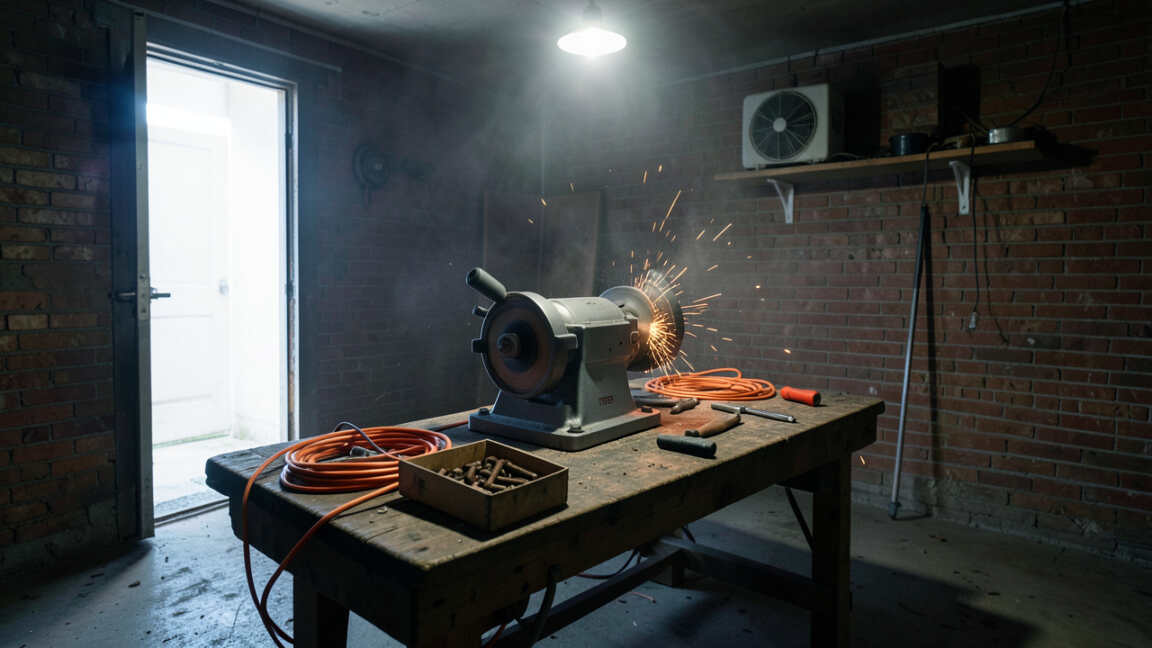
Ventilation is the single most important factor for safe bench grinder use in a garage. Without it, particle concentration rises exponentially, noise bounces off walls, and heat builds up. Good ventilation solves multiple problems at once.
Natural vs. Mechanical Ventilation
Opening the garage door and a window creates cross-flow ventilation that can reduce particle concentration by 60-80 percent. But this is not always practical in cold weather or attached garages where fumes can enter the house.
Mechanical ventilation provides a controlled solution. A ducted exhaust fan installed near the grinding area pulls contaminated air directly outside before it can circulate through the garage. The American Society of Heating, Refrigerating and Air-Conditioning Engineers (ASHRAE) recommends at least 6 air changes per hour for workshop spaces with grinding operations.
| Ventilation Method | Effectiveness | Cost | Best For |
|---|---|---|---|
| Open garage door + window | Moderate (60-80%) | Free | Mild weather, occasional use |
| Box fan in window | Moderate (50-70%) | $20-40 | Budget-friendly, temporary use |
| Ducted exhaust fan | High (90%+) | $150-400 | Regular use, attached garages |
| HEPA air purifier | High (90%+ for particles) | $100-500 | Year-round, combined with exhaust |
For most garage users, a combination of natural ventilation (opening the door) and a HEPA air purifier offers the best balance of effectiveness and cost. If you grind more than once a week, invest in a ducted exhaust fan to keep your garage air clean year-round.
Tip: Place your bench grinder within 4-6 feet of the garage door. Position a fan behind you blowing toward the open door. This pushes sparks and dust away from you and out of the garage.
Frequently Asked Questions
Is it safe to use a bench grinder in an attached garage?
It can be safe if you take proper precautions. Ensure cross-ventilation, remove all flammable materials, use a spark deflector, and wear full PPE. Never grind near the door leading into your house — seal gaps around the door with weatherstripping to prevent dust and fumes from entering living spaces.
Can a bench grinder start a fire in a garage?
Yes. Hot sparks from a bench grinder can ignite gasoline vapors, sawdust, cardboard, oily rags, and solvent fumes. The NFPA reports that sparks from tools cause about 15% of garage fires.
Keep all combustibles at least 15 feet away and have a fire extinguisher within reach at all times.
What type of fire extinguisher do I need for a bench grinder in a garage?
A Class A-B-C fire extinguisher covers ordinary combustibles, flammable liquids, and electrical fires. If you grind magnesium or aluminum, also keep a Class D extinguisher nearby. Mount the extinguisher within 10 feet of the grinder but not directly behind it where sparks could hit it.
Do I need a dust collector for a bench grinder in a garage?
Yes, a HEPA-filtered dust collector is strongly recommended. Without one, fine metal and abrasive dust accumulates on surfaces, damages electronics, and stays airborne for hours. A shop vacuum with a HEPA filter and a dust separator works well for most home garage setups.
Can I use a bench grinder in a garage with the door closed?
No. Using a bench grinder in a garage with the door closed creates a hazardous environment. Airborne particle concentration rises rapidly, oxygen levels can be affected by combustion, and noise levels become dangerous.
Always open the garage door or use mechanical ventilation when grinding.
Final Thoughts
Using a bench grinder in a garage comes with real risks — fire, lung damage, hearing loss, and tool degradation — but these risks are manageable with proper preparation. Focus on three priorities: ventilation to clear dust and fumes, spark control to prevent fires, and full PPE to protect your body. Set up your workspace deliberately, maintain your equipment, and never cut corners on safety.
A well-prepared garage workshop lets you grind with confidence and keep your projects on track.