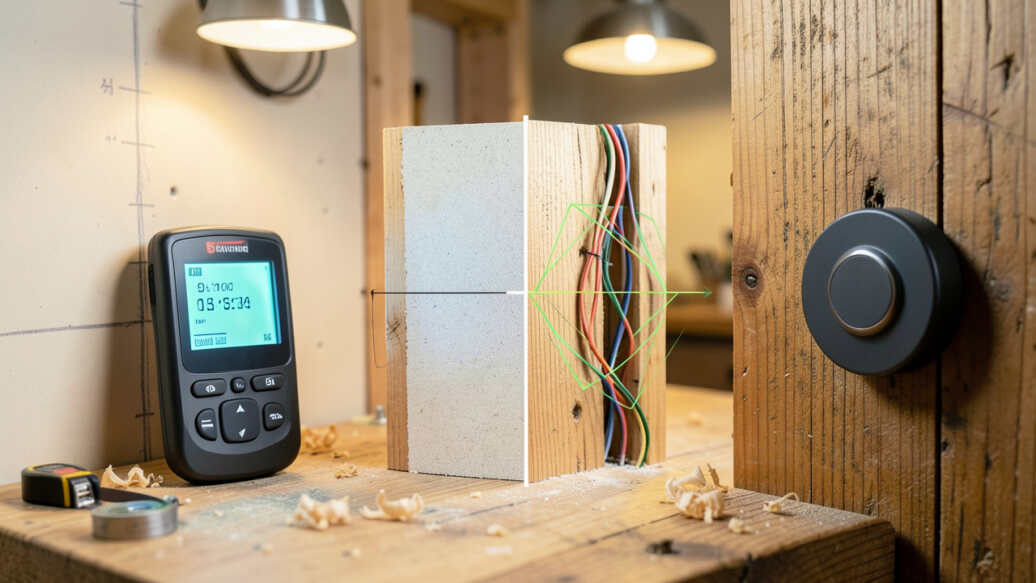

For a DIY workshop, an electronic stud finder is better overall because it detects wood and metal studs up to 1.5 inches deep and can identify live wires, whereas a magnetic finder only locates metal fasteners on the surface. The magnetic finder excels in speed, simplicity, and zero battery reliance, making it ideal for quick, shallow scans on standard drywall. To cover all workshop tasks like mounting heavy shelves or installing pegboard, owning both tools is ideal, but if you must choose one, a quality electronic stud finder offers deeper detection and critical safety features.
Choosing between a stud finder or magnetic finder can be confusing when you are setting up your DIY workshop for the first time. This guide breaks down exactly how each tool works, what they cost, and which one gives you the most reliable results for common workshop tasks like mounting shelves, hanging cabinets, or installing pegboard.
Simply put, an electronic stud finder is better for deep scanning and detecting live wires, while a magnetic finder is better for speed, simplicity, and zero battery reliance. For most DIY workshops, owning both is ideal, but if you only buy one, start with a quality electronic stud finder for deeper detection and safety features.
Key Takeaways
- A stud finder uses electronic sensors to detect wood or metal studs behind drywall, plaster, and thicker wall materials.
- A magnetic finder locates metal fasteners like screws or nails that attach drywall to studs, offering a no-power alternative.
- Accuracy and depth vary significantly between the two, with electronic finders scanning up to 1.5 inches deep versus magnetic finders detecting only surface-level metal.
- Safety features like AC wire detection are exclusive to electronic stud finders, reducing the risk of drilling into live electrical lines.
- Your specific workshop needs determine the better tool — frequent deep scans favor electronic, while quick spot checks favor magnetic.
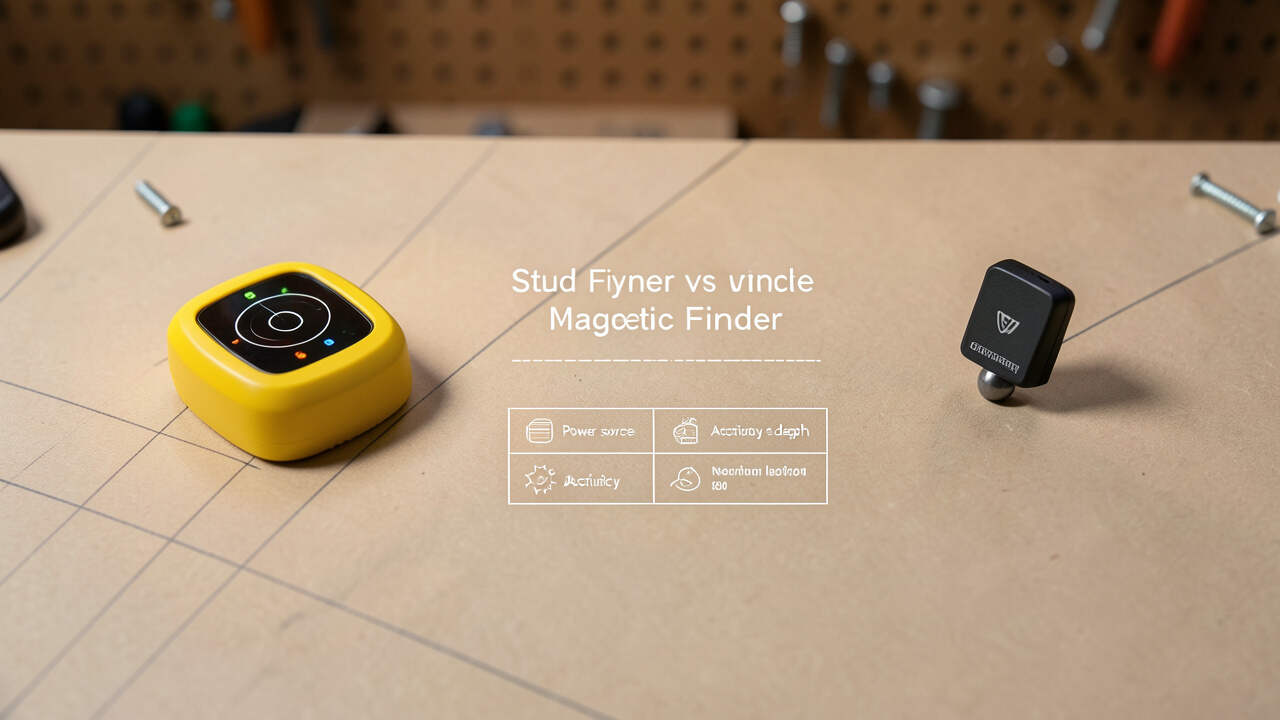
1. Quick Comparison Table: Stud Finder vs Magnetic Finder
Before diving into the details, here is a side-by-side comparison of the two tools across key performance metrics. This table gives you an instant snapshot of what each device can and cannot do.
| Feature | Electronic Stud Finder | Magnetic Stud Finder |
|---|---|---|
| Detection Method | Capacitance or radar sensor | Neodymium magnet |
| Maximum Detection Depth | 1.5 inches (3.8 cm) | 0.5 inches (1.3 cm) through drywall |
| Power Source | 9V battery or AA batteries | None (passive) |
| Detects | Wood studs, metal studs, live AC wires | Steel screws, nails, metal studs |
| Accuracy | Very high (with calibration) | Moderate (depends on fastener presence) |
| False Positives | Possible with uneven walls | Rare (only metal triggers) |
| Best For | Deep scans, live wire avoidance, thick walls | Quick spot checks, old homes, thin drywall |
| Average Price | $20 to $80 | $5 to $20 |
This comparison shows that each tool excels in different areas. An electronic stud finder gives you deeper detection and safety features, while a magnetic finder offers simplicity and a lower price point. Your choice depends on the wall types in your workshop and how often you plan to use the tool.
2. How an Electronic Stud Finder Works
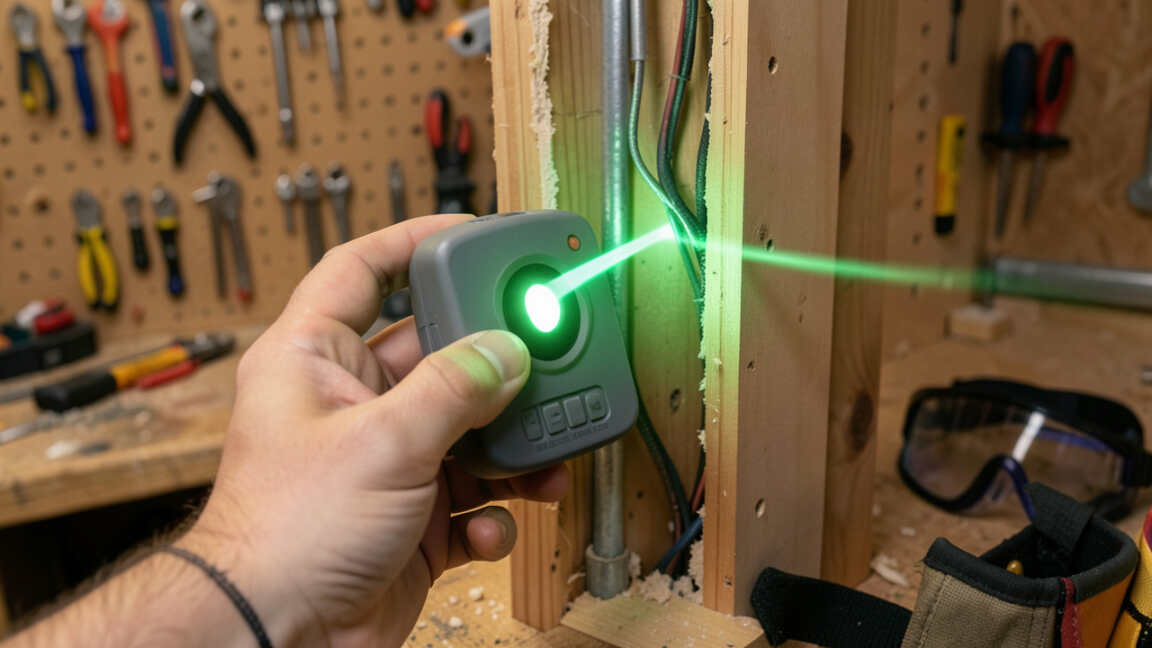
An electronic stud finder uses capacitance sensing or deep-scan radar technology to detect changes in wall density. When you move it across a wall, it measures the dielectric constant of the material. Drywall has a low constant, while a stud behind it has a much higher constant.
The device lights up or beeps when it detects that change.
Modern stud finders also include features like AC wire detection. This allows you to scan for live electrical cables behind the wall before you drill. According to the Consumer Product Safety Commission, drilling into live wires causes over 2,000 injuries annually in the United States.
A quality electronic stud finder with wire detection significantly reduces that risk.
Key Features to Look For in a Stud Finder
- Deep scan mode: Scans up to 1.5 inches for thick plaster or tile backing
- AC wire detection: Alerts you to live electrical cables behind the wall
- Auto-calibration: Adjusts sensitivity to wall type for fewer false positives
- Center-find marking: Shows both edges of the stud so you can mark the center
- Metal detection mode: Detects metal pipes and rebar in addition to studs
- Backlit display: Useful in dim workshop lighting conditions
- Ergonomic grip: Helps you maintain smooth contact with the wall during scanning
Important: Always calibrate your electronic stud finder on a flat, empty section of the wall before scanning. Hold it flat against the surface and press the calibration button. Move slowly — rushing causes the sensor to miss subtle density changes.
Electronic stud finders work best on consistent wall surfaces like standard drywall or wood paneling. They struggle on textured walls, plaster over lath, or surfaces with metal mesh. In those cases, you may need to use a combination of the electronic finder and a magnetic finder to confirm your marks.
3. How a Magnetic Stud Finder Works
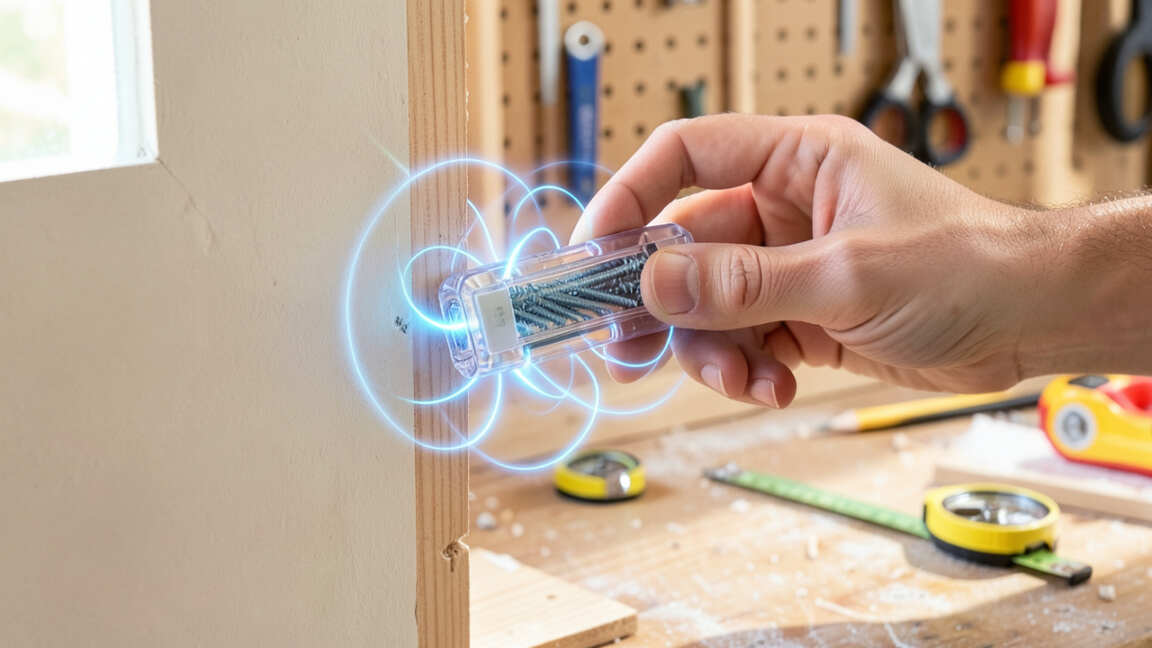
A magnetic stud finder is a simple passive device containing a powerful neodymium magnet. It detects the steel screws or nails that attach drywall to studs. When you slide it across the wall, the magnet pulls toward any ferrous metal fastener.
You feel a tug, and the device sticks to that spot. That is where the stud is located.
Magnetic finders are completely passive. They require no batteries, no calibration, and no electronic components. According to Fine Homebuilding, a magnetic finder is often more reliable in old homes where drywall compound, paint layers, or uneven surfaces confuse electronic sensors.
The simplicity is a major advantage for many DIYers.
Limitations of Magnetic Finders
- Only detects metal fasteners: If the drywall was glued or fastened with non-ferrous clips, the magnet finds nothing
- Shallow detection: Magnets typically work through one layer of drywall (0.5 inches) but struggle with thicker plaster
- False negative risk: If screws are recessed too deep or covered by thick paint, the magnetic pull may be too weak to feel
- No wire detection: Magnetic finders cannot detect electrical cables, pipes, or other hazards
- Slow for large areas: You must scan every few inches to find each fastener, which takes time
- Requires touch sensitivity: Some users miss weak tugs if they move too quickly
Tip: Use a magnetic finder with a rare-earth neodymium magnet rated at least N52 grade. These magnets are strong enough to detect screws through dual layers of drywall and even some thin plywood paneling.
Magnetic finders excel in workshops built with standard wood framing where drywall screws are evenly spaced at 16 or 24 inches. Once you find one screw, you can measure out from that point to locate the rest of the stud. They are also excellent for finding metal studs in commercial workshop settings.
4. Which One is Safer for Your Workshop?
Safety is a major consideration when you compare a stud finder or magnetic finder for workshop use. The electronic stud finder has a clear advantage here because it can detect live AC wires behind the wall. Drilling into a live wire can cause serious injury, fire, or damage to your electrical system.
The National Electrical Code requires that wires be run through studs at least 1.25 inches from the face of the stud. But in older workshops, wires may be stapled closer to the surface or run through unprotected areas. A stud finder with AC wire detection gives you an extra layer of awareness.
Safety Feature Comparison
| Safety Feature | Electronic Stud Finder | Magnetic Finder |
|---|---|---|
| Live AC Wire Detection | Yes | No |
| Pipe Detection | Yes (metal mode) | No |
| No Power Required | No | Yes |
| No Battery Failure Risk | No | Yes |
| No Calibration Errors | No | Yes |
If safety is your top priority, an electronic stud finder with AC wire detection is the better choice. However, you can improve safety with a magnetic finder by using a wire detector as a secondary tool. Many experienced DIYers use both in combination for maximum confidence before drilling.
Warning: Never rely solely on a magnetic finder when working near light switches, outlets, or junction boxes. The absence of metal fasteners does not mean wires are absent. Always use a non-contact voltage tester in addition to your stud finder.
5. Accuracy and Reliability in Real Scenarios
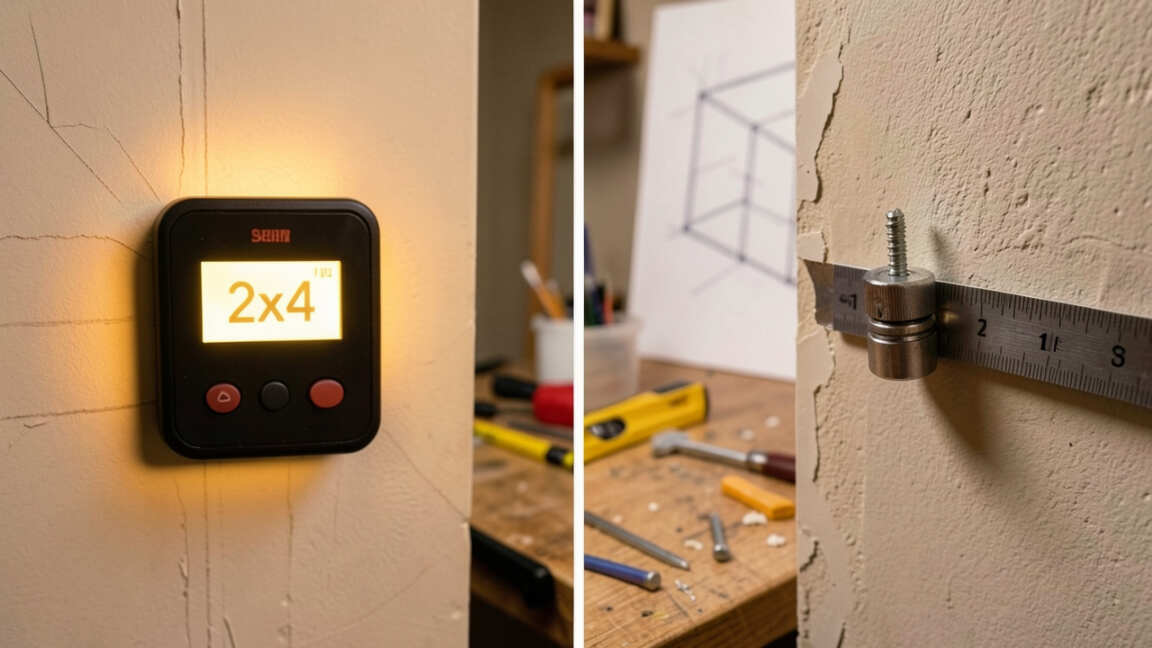
Accuracy varies widely between these two tools depending on the wall construction. In a modern workshop with standard 0.5-inch drywall over wood studs at 16-inch centers, both tools work reasonably well. But when conditions get trickier, the electronic stud finder tends to outperform the magnetic version.
The National Association of Home Builders reports that roughly 30 percent of homes built before 1980 use plaster and lath construction. In these walls, electronic stud finders often give false positives because the wood lath creates inconsistent density. A magnetic finder that detects the original nails can be more reliable in that situation.
Scenario-by-Scenario Accuracy
- Standard drywall over wood studs: Both tools work well. Electronic gives you the center. Magnetic gives you the fastener location.
- Plaster over lath (pre-1980 homes): Magnetic finder is usually more reliable because electronic sensors get confused by the uneven surface.
- Thick tile or stone veneer: Electronic stud finder with deep scan mode is required. Magnetic finder cannot penetrate these materials.
- Metal studs: Both tools work. Magnetic finder sticks directly to the stud. Electronic finder detects the metal edge.
- Textured or popcorn ceilings: Electronic finder struggles with the uneven surface. Magnetic finder works if fasteners are present.
- Double drywall or soundproofing layers: Deep-scan electronic finder is necessary. Magnetic finder cannot reach screws behind the first layer.
For a DIY workshop, accuracy also depends on your technique. With an electronic finder, you must move in a straight line at a consistent speed. With a magnetic finder, you need to move slowly and feel for the pull.
Practicing on a known wall helps you understand how each tool behaves.
6. Cost and Value for a DIY Workshop
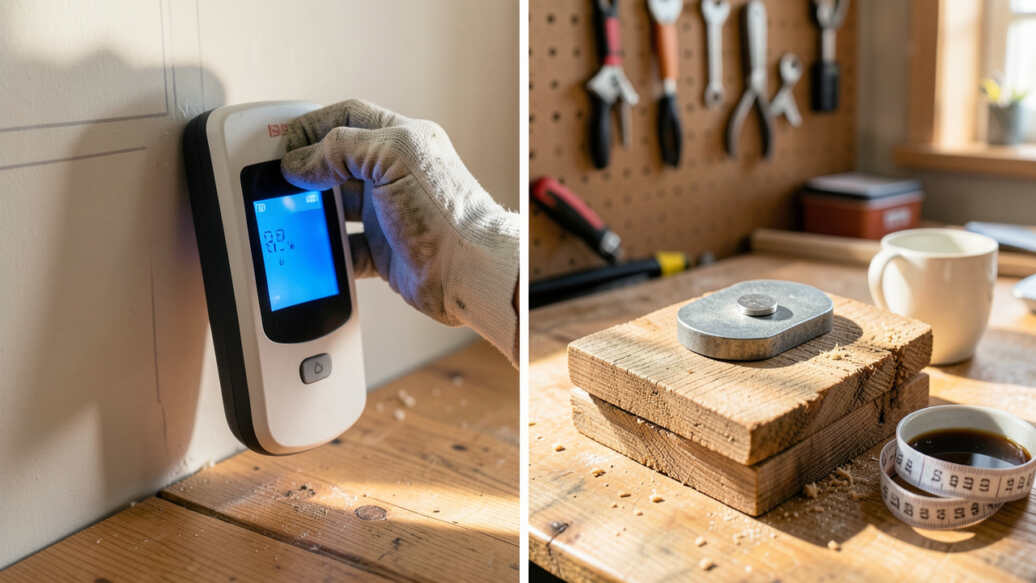
Budget is a practical concern for most DIYers setting up a workshop. Magnetic stud finders are cheap, often costing under $10. A good neodymium model from a reputable brand runs $8 to $15.
You can buy three or four for the price of one basic electronic stud finder.
Electronic stud finders range widely in price. A basic model with standard detection costs $20 to $30. A mid-range model with AC wire detection and center-find marking runs $35 to $50.
Premium models with deep scan radar, multiple modes, and digital displays cost $60 to $80.
Cost Breakdown by Use Case
| Use Case | Recommended Tool | Estimated Cost |
|---|---|---|
| Quick weekend projects | Magnetic finder | $8 – $15 |
| General workshop shelving | Basic electronic stud finder | $20 – $30 |
| Heavy cabinet installation | Mid-range electronic with wire detection | $35 – $55 |
| Plaster and old home renos | Both electronic + magnetic | $45 – $70 total |
| Professional contracting | Premium stud finder + separate wire detector | $80 – $120 |
The best value for a DIY workshop is a mid-range electronic stud finder paired with a cheap magnetic finder. You get the deep scanning and wire detection of the electronic tool plus the reliability and zero-power backup of the magnetic tool. Total investment is around $50 to $60.
7. How to Choose the Right Tool for Your Workshop Setup
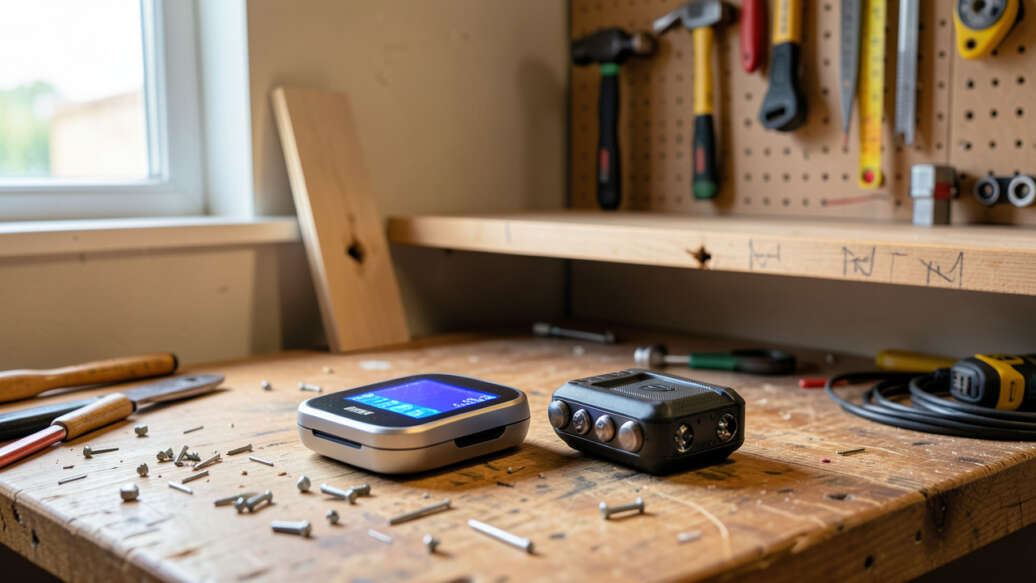
Your workshop space determines which tool you need most. If your workshop is in a modern garage with standard drywall over wood studs and you only need to hang a few shelves, a magnetic finder is sufficient. It is cheap, simple, and gets the job done for basic mounting.
If your workshop is in a basement with concrete walls, a finished room with plaster, or a commercial space with metal studs, an electronic stud finder is the better investment. You need the depth and versatility that only an electronic sensor can provide.
Decision Flowchart
- What are your walls made of? Drywall, plaster, tile, or paneling? Drywall is easy for both. Plaster favors magnetic. Tile favors electronic.
- How often do you drill into walls? Once a month? Magnetic finder is fine. Every weekend? Invest in an electronic finder.
- Do you need to avoid electrical wires? If yes, choose an electronic stud finder with AC wire detection. Magnetic finders cannot detect wires.
- What is your budget? Under $20? Get a magnetic finder. Under $50? Get a quality electronic finder. Over $50? Buy both.
- Do you work with metal studs? If yes, a magnetic finder works great because it sticks directly to the metal flange.
Tip: If you already own a strong magnet from an old hard drive or speaker, you can test it as a magnetic finder before buying one. Wrap it in tape to avoid scratching the wall and slide it around. If it sticks, you found a screw.
The final choice between a stud finder or magnetic finder comes down to the balance of depth, safety, and simplicity. For a comprehensive workshop tool kit, having both tools covers every scenario you will encounter.
Frequently Asked Questions
Can a magnetic stud finder detect wood studs?
No, a magnetic stud finder does not detect wood directly. It detects the steel screws or nails that attach drywall to wood studs. You locate the fastener and then infer the stud position behind it.
Which type of stud finder is most accurate?
An electronic stud finder with center-find marking is generally most accurate for locating the exact center of a stud. Magnetic finders can only show where the screw is, which may be off-center by up to 0.5 inches.
Do stud finders work on plaster and lath walls?
Electronic stud finders often struggle with plaster and lath because the surface is uneven and the wood lath creates density fluctuations. A magnetic finder is usually more reliable for detecting the original nails in lath construction.
How do I avoid drilling into wires when using a magnetic finder?
You cannot avoid wires with a magnetic finder alone. Use a non-contact voltage tester or an electronic stud finder with AC wire detection in addition to your magnetic finder. Always check for wires before drilling.
Is a stud finder worth it for a small home workshop?
Yes, even a basic $20 electronic stud finder saves you time and prevents mistakes. It pays for itself after one or two projects by avoiding misplaced holes, damaged drywall, or accidental wire strikes.
Final Thoughts
Choosing between a stud finder or magnetic finder does not need to be difficult. An electronic stud finder gives you depth, safety features, and versatility for most workshop tasks. A magnetic finder offers simplicity, reliability in tricky walls, and zero battery dependency.
The smartest approach is to own both — use the electronic finder for deep scans and wire detection, and keep the magnetic finder as a quick backup for fast jobs. Your workshop projects will be safer, faster, and more accurate with the right tool in your hand.